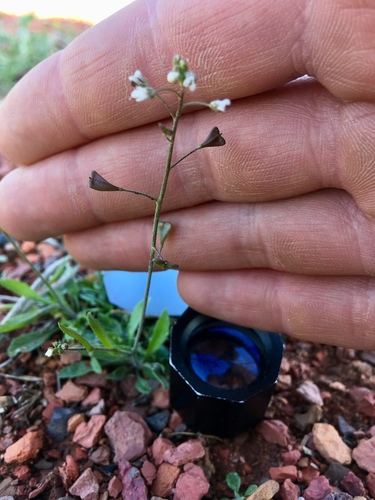
Capsella, Genus, bursa-pastoris, Species,
- Genus & species
shepherd's purse
Native to Europe and western Asia; naturalized on every continent — the species ranks among the more widely distributed flowering plants globally, occurring in cultivated fields, gardens, sidewalk cracks, lawns, roadsides, and virtually any disturbed ground from sea level to over 14,000 ft (4,300 m); in the Pacific Northwest plants germinate year-round during mild periods and the species carries open flowers in every month of the year during mild winters
Overview
Capsella bursa-pastoris is a winter or summer annual — occasionally biennial — in the mustard family (Brassicaceae) reaching 4-20 inches (10-50 cm) tall with a compact 4-8 inch (10-20 cm) spread. Plants begin as a basal rosette of highly variable leaves, typically lobed to deeply pinnatifid, 1-4 inches (2.5-10 cm) long, resembling dandelion leaves in shape. Flowering stems are erect, slender, and sparsely branched, carrying small lance-shaped clasping stem leaves with pointed auricles. Flowers are white, four-petaled, 0.1 inch (2-3 mm) across, borne in elongating terminal racemes. The fruit is a flattened heart-shaped to triangular silicle 0.2-0.3 inch (5-8 mm) long, notched at the apex, containing 10-20 tiny orange-brown seeds per pod — the heart-shaped pod is the identification character the species is known for and the source of the common name (the silicle resembles a medieval coin purse). A single plant produces 2,000-40,000 seeds depending on growing conditions. Seeds remain viable in soil for up to 35 years. Plants complete the life cycle in as few as 6 weeks under favorable conditions and may produce 2-4 generations per year in mild climates. The species ranks among the more widely distributed flowering plants globally, occurring on every continent including Antarctica.
Native Range
Capsella bursa-pastoris is native to Europe and western Asia. Naturalized on every continent, occurring from sea level to over 14,000 ft (4,300 m) elevation. Found in cultivated fields, gardens, sidewalk cracks, lawns, roadsides, and virtually any disturbed ground. In the Pacific Northwest, plants germinate year-round during mild periods.Suggested Uses
Used in plant biology courses as a model organism related to Arabidopsis thaliana for demonstrating Brassicaceae morphology. Young rosette leaves are consumed as salad greens and potherbs in East Asian and European cuisines. Used in weed ecology research as a study species for soil seed bank longevity. Seeds are consumed by house sparrows and other granivorous birds.How to Identify
Appearance
Size & Dimensions
Height4" - 1'8"
Width/Spread4" - 8"
Bloom Information
Flowers year-round in mild climates; in colder regions, the primary flowering window runs March through November. Plants germinate in fall or early spring and flower within 6-8 weeks of germination. Individual racemes continue elongating and flowering for 4-6 weeks. In the Pacific Northwest, flowering peaks in April through June but plants with open flowers can be found in every month of the year during mild winters. Self-pollinating; seed set does not depend on insect visitation.
Detailed Descriptions
Flower Description
White four-petaled flowers 0.1 inch (2-3 mm) across carried in elongating terminal racemesFoliage Description
Medium green basal leaves lobed to deeply pinnatifid in a rosette (resembling dandelion leaves in shape); stem leaves lance-shaped with pointed basal auricles that clasp the stemGrowing Conditions
Sun Requirements
Requires 4-12 hours of direct sunlight daily
• Full Sun: 6+ hours of direct sunlight
• Partial Shade: 3-6 hours of direct sunlight
• Full Shade: Less than 3 hours of direct sunlight