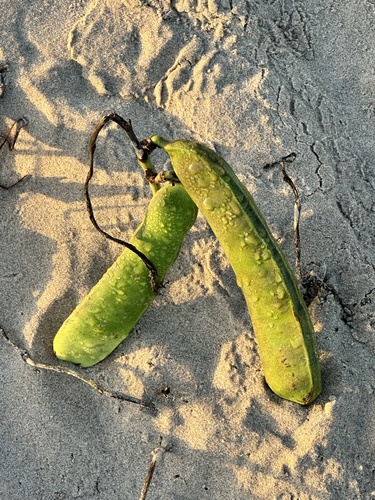
Canavalia, Genus, rosea, Species,
- Genus & species
beach bean
Overview
Canavalia rosea is a trailing, mat-forming legume of tropical and subtropical coasts, sending runners up to 20 feet (6 m) long across open sand. The stems root at the nodes and carry leaves divided into three rounded leaflets, each 2-4 inches (5-10 cm) long, thick and leathery to withstand salt spray and sun. Pink to rose-purple pea flowers about 0.8-1.2 inches (2-3 cm) long are borne on upright stalks held above the foliage. The flowers are followed by woody pods 4-6 inches (10-15 cm) long containing several hard brown seeds that float and remain viable in seawater, spreading the plant between beaches. A deep taproot anchors the plant and reaches moisture below the sand. It grows on foredunes and the strand line, binding loose sand and tolerating salt, wind, and brief inundation. The hard-coated seeds contain toxic compounds and are not eaten raw. The plant is tender to frost and is restricted to warm coastal climates.
Native Range
Canavalia rosea has a pantropical distribution on sandy shores, including the coasts of northern and eastern Australia, Asia, Africa, the Pacific, and the Americas. It grows on foredunes, beach ridges, and the upper strand line.Suggested Uses
Used for dune stabilisation and erosion control on exposed sandy coasts. Planted as a salt- and wind-tolerant groundcover in frost-free seaside gardens. Its sand-binding runners suit revegetation of degraded foreshores.How to Identify
Appearance
Size & Dimensions
Height6" - 1'
Width/Spread10' - 20'
Bloom Information
Detailed Descriptions
Foliage Description
greenGrowing Conditions
Sun Requirements
Requires 6-12 hours of direct sunlight daily
• Full Sun: 6+ hours of direct sunlight
• Partial Shade: 3-6 hours of direct sunlight
• Full Shade: Less than 3 hours of direct sunlight