Caleana, Genus, major, Species,
- Genus & species
large flying duck orchid
Overview
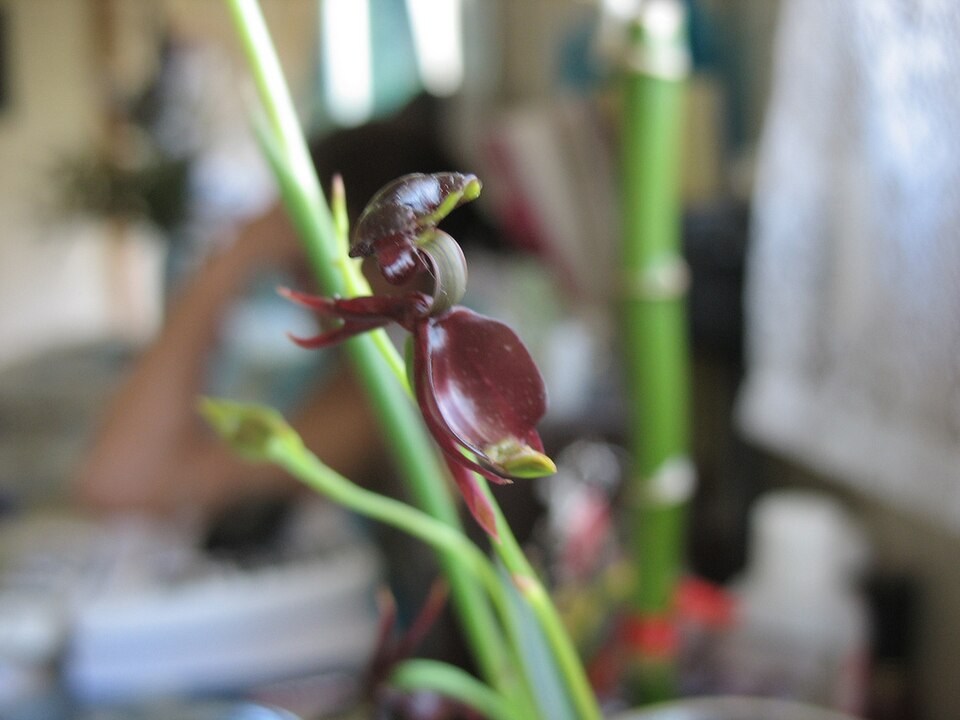
Caleana major is a terrestrial tuberous orchid producing a single slender flowering stem 8-20 inches (20-50 cm) tall from an underground tuber. A solitary narrow, grass-like leaf 4-6 inches (10-15 cm) long emerges at the base, often reddish at maturity. Each stem carries 1 to 4 flowers held inverted, 0.6-0.8 inch (15-20 mm) long, dark reddish-brown to maroon with a greenish tint. The hinged labellum is raised on a strap-like claw and resembles the head and bill of a duck in flight, which gives the flower its shape. The labellum is touch-sensitive: when an insect lands, it snaps downward against the column within a second, trapping the pollinator briefly before releasing it. Flowering occurs in spring and early summer, after which the plant dies back to its tuber and stays dormant through summer. Growth depends on a symbiotic soil fungus, and plants rarely persist when transplanted or removed from their native soil. Populations are scattered and easily overlooked among heath and open forest groundcover.
Native Range
Native to eastern and southeastern Australia, from southern Queensland through New South Wales, Victoria, Tasmania, and South Australia. Grows in well-drained sandy soils of heathland, coastal scrub, and open eucalypt forest, often among leaf litter and low shrubs.Suggested Uses
Grown by specialist native-orchid enthusiasts in containers that replicate its seasonal wet-dry cycle and fungal associations. Occurs in conservation and bushland regeneration settings rather than general garden plantings. Not suited to mixed borders or standard cultivation.How to Identify
Appearance
Size & Dimensions
Height8" - 1'8"
Width/Spread2" - 4"
Bloom Information
Flowers from September to January depending on latitude and altitude, with peak flowering in October and November in southeastern Australia. Each plant blooms for 2-4 weeks. Flowering is irregular between seasons and is often heavier in the year following summer bushfire.
Detailed Descriptions
Flower Description
maroon to reddish-brownFoliage Description
green to reddishGrowing Conditions
Sun Requirements
Requires 2-5 hours of direct sunlight daily
• Full Sun: 6+ hours of direct sunlight
• Partial Shade: 3-6 hours of direct sunlight
• Full Shade: Less than 3 hours of direct sunlight
Care & Maintenance
Care Guide
Grows from a dormant tuber that sprouts in autumn, flowers in spring, and dies back by mid-summer. It needs consistently moist but well-drained sandy soil during active growth and dry conditions through summer dormancy. The plant depends on a specific mycorrhizal fungus for germination and nutrition, which makes reliable cultivation difficult outside its native habitat. It grows in dappled to part shade beneath an open canopy. Plants decline when groundcover, leaf litter, or soil structure is disturbed.Pruning
No pruning is applicable. The single leaf and flowering stem wither naturally as the plant enters summer dormancy, and dead material can be left in place over the tuber.Container Growing
Suitable for container growing
Minimum container size: 1 gallons