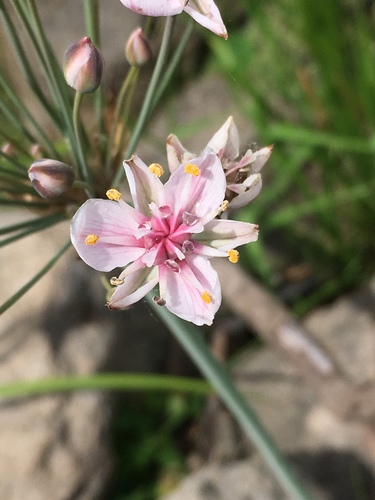
Butomus, Genus, umbellatus, Species,
- Genus & species
flowering rush
Native to temperate Europe and Asia, growing in shallow freshwater margins, slow-moving rivers, ditches, and lakeshores from sea level to approximately 3,300 ft (1,000 m); introduced to North America in the late 1800s and now listed as a prohibited or regulated invasive aquatic species in most northern U.S. states and Canadian provinces; the Great Lakes, Columbia River basin, and northern Great Plains carry the densest infestations; diploid populations reproduce by seed and rhizome, triploid populations reproduce primarily by vegetative bulbils and rhizome fragmentation, and infestations form dense monocultures along lakeshores and slow-moving waterways that displace native emergent wetland vegetation
Overview
Butomus umbellatus is an emergent aquatic perennial in the family Butomaceae — the only species in its genus — reaching 36-60 inches (90-150 cm) tall from a thick creeping rhizome. Basal leaves are linear, 0.2-0.4 inch (5-10 mm) wide and up to 40 inches (100 cm) long, triangular in cross-section, often twisted at the tips, emerging from a fleshy rhizome. Flowers open in a terminal umbel of 20-30 blooms on a leafless scape. Individual flowers are 0.75-1 inch (18-25 mm) across with three pink to white petals and three smaller pink sepals, each with darker pink veins. Fruit is a cluster of six beaked follicles carrying numerous tiny seeds. The rhizome spreads laterally at 4-8 inches (10-20 cm) per year in soft substrates and also produces vegetative bulbils that detach and disperse downstream. Listed as a prohibited or regulated invasive aquatic species across most northern U.S. states and Canadian provinces. Diploid populations reproduce by seed and rhizome; triploid populations reproduce primarily by vegetative bulbils and rhizome fragmentation. Infestations alter native wetland plant communities by forming dense monocultures along lakeshores and slow-moving waterways.
Native Range
Butomus umbellatus is native to temperate Europe and Asia, occurring in shallow freshwater margins, slow-moving rivers, ditches, and lakeshores. Found from sea level to approximately 3,300 ft (1,000 m) in the native range. Introduced to North America in the late 1800s and now invasive across the northern United States and southern Canada, particularly in the Great Lakes, Columbia River basin, and northern Great Plains.Suggested Uses
Studied in aquatic invasive species management and wetland restoration ecology. Included in aquatic plant identification courses for natural resource managers and lake association volunteers. In the native European range, the species is a component of natural marsh and riverbank communities and is occasionally planted in ornamental water gardens.How to Identify
Appearance
Size & Dimensions
Height3' - 5'
Width/Spread1' - 2'
Bloom Information
Flowers from June through August across a 4-week bloom window. Individual flowers open for 3-5 days. The umbel blooms progressively over 2-4 weeks with outer flowers opening first. In the Pacific Northwest, flowering runs primarily in July. Triploid populations flower less frequently and produce fewer viable seeds than diploid populations — the triploid reproductive deficit is offset by vigorous vegetative spread through rhizome fragmentation and bulbil dispersal. Pollinated by generalist insects including flies and bees.
Detailed Descriptions
Flower Description
Pink to white flowers 0.75-1 inch (18-25 mm) across carried in a terminal umbel of 20-30 blooms on a leafless scape; each flower carries three pink to white petals and three smaller pink sepals, each with darker pink veinsFoliage Description
Dark green narrow linear basal leaves triangular in cross-section, twisted near the tips, 0.2-0.4 inch (5-10 mm) wide and up to 40 inches (100 cm) long, emerging from a fleshy rhizomeGrowing Conditions
Sun Requirements
Requires 6-10 hours of direct sunlight daily
• Full Sun: 6+ hours of direct sunlight
• Partial Shade: 3-6 hours of direct sunlight
• Full Shade: Less than 3 hours of direct sunlight