Brasenia, Genus, schreberi, Species,
- Genus & species
Watershield
North America and worldwide temperate regions
Overview
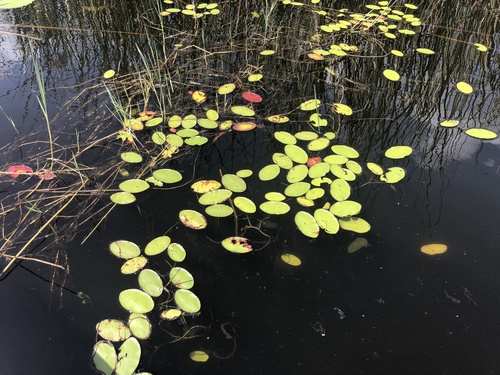
Brasenia schreberi is a rooted aquatic perennial in the watershield family, growing from slender rhizomes anchored in the mud of ponds and slow streams, with long, flexible stems that reach the surface. The floating leaves are oval to elliptical, 1.5-4.5 inches (4-11 cm) long, with the stalk attached at the center of the underside, so each leaf sits like a small shield on the water. A thick, clear gelatinous slime coats the stems, buds, and leaf undersides, a feature that sets the plant apart. In summer it raises small, dull purple to reddish flowers about 0.5-0.75 inch (12-18 mm) wide on stalks just above the surface; each opens over two days, female on the first and male on the second, and is wind-pollinated. Small leathery fruits follow and ripen underwater. It grows in still or slow fresh water 1-6 feet (0.3-1.8 m) deep, in ponds, lakes, ditches, and quiet stream margins, on soft, acidic, mucky bottoms. The plant occurs across much of North America and on several other continents. It can form dense floating mats that shade out other aquatics. Clear, soft, acidic water and a muddy bottom are its normal conditions, and it is intolerant of strong currents and turbid, hard water.
Native Range
Native across much of North America, from Canada south through the United States, and also found in eastern Asia, Africa, Australia, and parts of Central America. It grows in ponds, lakes, oxbows, ditches, and slow streams with soft, acidic water. Its broad distribution covers many temperate and warm regions worldwide.Suggested Uses
Brasenia schreberi is used in natural ponds, water gardens, and wetland restoration for surface cover, fish habitat, and waterfowl food, since ducks and other birds eat its seeds and foliage. Its floating shield-like leaves suit large, still ponds where it can spread. In some regions the young, jelly-coated leaves and shoots are eaten as a vegetable.How to Identify
Appearance
Size & Dimensions
Height1' - 6'
Width/Spread3' - 10'
Bloom Information
Flowering comes in summer, roughly June to September. The small dull-purple flowers rise just above the water and each lasts about two days, shifting from female to male phase. After pollination the flower stalk bends back underwater, where the fruit ripens.
Detailed Descriptions
Flower Description
dull purple to reddishFoliage Description
green above, purplish beneathGrowing Conditions
Sun Requirements
Requires 5-12 hours of direct sunlight daily
• Full Sun: 6+ hours of direct sunlight
• Partial Shade: 3-6 hours of direct sunlight
• Full Shade: Less than 3 hours of direct sunlight