Boykinia, Genus, major, Species,
- Genus & species
boykinia
Overview
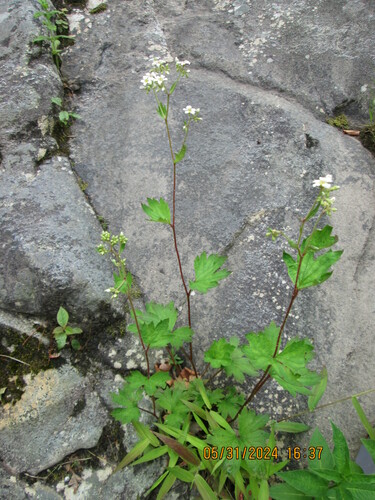
Boykinia major is a herbaceous rhizomatous perennial reaching 18-36 inches (45-90 cm) tall and 18-24 inches (45-60 cm) wide, forming dense clumps in saturated soils. Stems erect, glabrous to glandular-pubescent in the upper portion. Basal leaves long-petioled, broadly palmately 5-7 lobed and toothed, 3-6 inches (7.5-15 cm) across, dark green and slightly leathery. Stem leaves smaller, sessile, with deeply cut lobes. Flowers small, 0.3-0.5 inch (8-12 mm) across, with five white petals reflexed against a green calyx; borne in open branched panicles 4-8 inches (10-20 cm) long at the top of leafy stems. Bloom June through August. Seed capsules dry, two-beaked, 0.2-0.3 inch (5-8 mm), ripening in August-September. Spreads 4-8 inches (10-20 cm) per year by short rhizomes; clumps reach 18-24 inches (45-60 cm) wide within 3-4 years. Foliage dies back to ground level after first hard frost. Plants do not survive in soils that dry out below 30% moisture during the growing season; root crowns rot in dry sites within 1-2 seasons.
Native Range
Native to the Pacific Northwest of North America from southern Washington (Cascades) through Oregon to northwestern California (Klamath and Siskiyou ranges). Found along stream banks, in springs and seeps, and in saturated meadow margins of mixed conifer forest at 1,000-7,000 feet (300-2,100 m) elevation. Most populations occur in shaded sites with year-round soil saturation.Suggested Uses
Used in stream-margin and rain-garden plantings, bog garden margins, and shaded wetland restoration at 18-24 inch (45-60 cm) spacing in zones 5-8. Cannot tolerate seasonal drought and is rarely planted in mixed perennial borders without dedicated irrigation. Container culture is short-lived (2-3 seasons) due to its taproot system and high moisture requirement.How to Identify
Appearance
Size & Dimensions
Height1'6" - 3'
Width/Spread1'6" - 2'
Bloom Information
June through August across the range, with peak bloom in late June and July at low elevations and into early September above 5,000 feet (1,500 m). Individual flower panicles bloom for 2-3 weeks; total flowering on a single plant extends 4-6 weeks. Bloom is reduced after dry winters and fails entirely if soil moisture drops below 30% during May-June.
Detailed Descriptions
Foliage Description
Dark greenGrowing Conditions
Sun Requirements
Requires 2-5 hours of direct sunlight daily
• Full Sun: 6+ hours of direct sunlight
• Partial Shade: 3-6 hours of direct sunlight
• Full Shade: Less than 3 hours of direct sunlight
Care & Maintenance
Care Guide
Plants establish from rhizome divisions or 4-inch (10 cm) container stock spaced 18-24 inches (45-60 cm) apart, planted in fall or early spring with constant moisture. Maintain saturated to consistently moist soil throughout the growing season; plants decline rapidly within 2-3 weeks of soil drying. Powdery mildew may develop on foliage in dry late summers; cosmetic only. Few pest pressures occur in saturated wetland sites. Root crown lifespan 6-10 years; division every 4-5 years maintains clump size. Crown rot occurs in stagnant water but is rare in flowing seeps and stream margins.Pruning
Remove yellowing leaves at the base in late summer; cut entire plant to ground level in late fall or early winter. Spent flower stems can be cut back to basal rosette after seed dispersal in September; alternatively, leave for winter structure in shaded woodland gardens.Pruning Schedule
Prune: September–November
fall
Container Growing
Minimum container size: 3 gallons