Borodinia, Genus, laevigata, Species,
- Genus & species
smooth rockcress
Overview
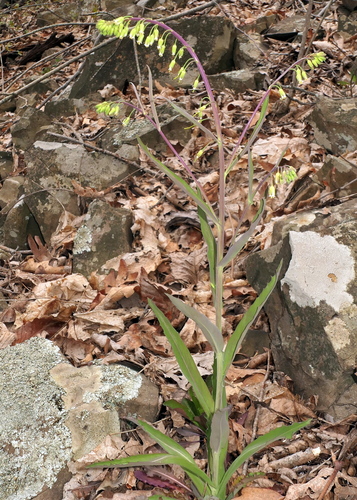
Borodinia laevigata is a slender biennial or short-lived perennial in the mustard family, growing 1-3 feet (30-90 cm) tall from a basal rosette. The smooth, blue-green leaves are hairless and waxy, the stem leaves narrow and arrow-shaped where they clasp the stalk, while basal leaves are toothed and spoon-shaped. Small flowers about 0.2 inch (5 mm) wide have four greenish-white to pale petals, carried in a loose cluster at the stem top in spring. The flowers give way to long, narrow seed pods, 2-4 inches (5-10 cm) long, that arch outward and downward as they ripen. The pods split to release flat, winged seeds. It grows in rocky woods, bluffs, ledges, and shaded slopes on calcareous or neutral soil. As a short-lived plant it depends on seed to persist and often grows as scattered individuals rather than colonies. Dense shade and dry soil reduce its size and seed set.
Native Range
Borodinia laevigata is native to eastern and central North America, from Ontario and Quebec south to Georgia and Arkansas. It grows in rocky woodlands, on shaded bluffs and ledges, and along wooded slopes, often over limestone.Suggested Uses
Planted in woodland and native plant gardens, shaded rock gardens, and naturalized slopes. It suits limestone or neutral-soil sites under deciduous trees. The early flowers supply nectar and pollen for small spring bees.How to Identify
Appearance
Size & Dimensions
Height1' - 3'
Width/Spread6" - 1'
Colors
Foliage Colors
Bloom Information
Small greenish-white flowers open in spring, generally April to May, in a loose terminal cluster. Bloom is brief, lasting one to two weeks, and the long seed pods soon follow. The pods ripen and shed seed through early summer.
Detailed Descriptions
Foliage Description
blue-greenGrowing Conditions
Sun Requirements
Requires 1-5 hours of direct sunlight daily
• Full Sun: 6+ hours of direct sunlight
• Partial Shade: 3-6 hours of direct sunlight
• Full Shade: Less than 3 hours of direct sunlight
Care & Maintenance
Care Guide
Grow Borodinia laevigata in part to full shade in moist but well-drained, rocky or loamy soil with a pH from 6.5 to 7.5. It favors the cool, shaded conditions of a woodland slope and tolerates thin soil over rock. As a short-lived plant it relies on self-sown seed, which germinates in autumn or spring. It transplants poorly because of its taproot and is usually grown from seed sown in its final position. Dry, exposed sites shorten its life and reduce flowering. Little care is needed in a suitable shaded spot.Pruning
No pruning is needed. Seed pods can be left to ripen and self-sow or removed before they split to limit seedlings. Spent stems can be cut back after seed drop.Toxicity
Non-toxicPlanting Guide
Planting Methods & Timing
Planting Method
direct sow
Plant Spacing
10 inches