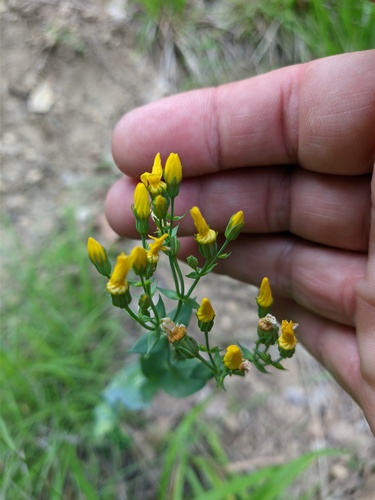
Blackstonia, Genus, perfoliata, Species,
- Genus & species
Yellow-wort
Western and southern Europe, the Mediterranean, North Africa, and western Asia
SunFull Sun
Overview
Blackstonia perfoliata is an erect annual herb 6-18 inches (15-45 cm) tall with a strongly glaucous, blue-grey cast over the whole plant. A basal rosette of spoon-shaped leaves forms first, followed by triangular stem leaves that fuse in opposite pairs around the stem (perfoliate), so the stem appears to pass through a single disc of leaf tissue at each node. Branching stems carry loose clusters of yellow flowers 0.4-0.6 inch (10-15 mm) across, each with six to twelve narrow petals, most often eight, joined at the base into a short tube. Flowers open in full sun from June to September and close in dull weather. Slender capsules follow, splitting to release numerous tiny seeds. The plant completes its life cycle in one season, germinating in autumn or spring and dying after seeding. It grows only where soils stay open and lime-rich, and is absent from acid or densely vegetated ground.
Native Range
Native to western and southern Europe, the Mediterranean basin, North Africa, and western Asia. It grows on chalk and limestone grassland, calcareous dunes, quarry floors, and other open, base-rich soils, mostly at low elevations.Suggested Uses
Grown in wildflower and chalk-grassland seed mixes, gravel gardens, and conservation plantings on lime-rich soils, sown thinly where it can self-seed. Suited to open, sunny, low-fertility sites rather than borders or containers. Flowers draw bees and hoverflies in summer.How to Identify
Appearance
Size & Dimensions
Height6" - 1'6"
Width/Spread4" - 8"
Colors
Flower Colors
Foliage Colors
Bloom Information
Flowers from June to September, with peak bloom in July and August. Individual flowers open in direct sun and close by afternoon or in overcast weather, each lasting a day or two. A plant flowers over 6-8 weeks as successive buds open along the branches.
Detailed Descriptions
Foliage Description
blue-grey greenGrowing Conditions
Sun Requirements
Requires 6-10 hours of direct sunlight daily
• Full Sun: 6+ hours of direct sunlight
• Partial Shade: 3-6 hours of direct sunlight
• Full Shade: Less than 3 hours of direct sunlight
Water & Climate
Water Needs
Drought Tolerance
Drought tolerant when established
Care & Maintenance
Care Guide
Grows in full sun on free-draining, lime-rich soils that stay open and sparsely vegetated. It tolerates drought and thin, stony ground but fails in shade, acid soil, or dense turf. As an annual it is raised from seed sown in autumn or early spring on a firm, weed-free surface, and does not transplant well because of its taproot. No feeding is needed, and rich soils favour competing grasses that crowd it out. Self-sown seedlings maintain a colony where the ground stays bare between plants. It has no significant pest or disease problems.Pruning
No pruning is required. Seedheads are left to ripen and shed seed for the following year, since the plant is annual and does not regrow from the root. Spent plants are cleared after seed has dropped.Toxicity
Non-toxicPlanting Guide
Planting Methods & Timing
Planting Method
direct sow
Direct Sow Timing
autumn or early spring