Bigelowia, Genus, nuttallii, Species,
- Genus & species
Nuttall's rayless goldenrod
Southeastern United States, primarily on sandhill and pine savanna habitats from Virginia south to Florida
Overview
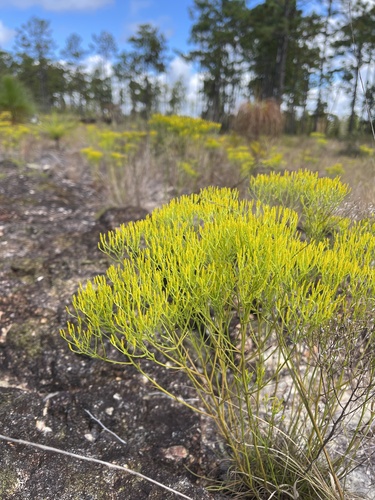
Bigelowia nuttallii is a slender, upright native perennial in the Asteraceae family that grows 12–24 inches (30–60 cm) tall and 8–12 inches (20–30 cm) wide. Narrow, linear gray-green leaves are resinous and sticky to the touch, arranged alternately along wiry stems. Flat-topped clusters of small, yellow disc-only flower heads (lacking ray florets) appear from August through October. The absence of ray florets gives the genus its common name rayless goldenrod — the flowers are composed entirely of tubular disc florets. This species occurs naturally in fire-maintained pine savannas and sandhill communities in the southeastern United States, growing on acidic, infertile sandy soils where competition from other species is limited by frequent burning and low fertility. In cultivated garden settings without fire or very lean soil, surrounding vegetation outcompetes the slender plants. The species is rarely cultivated and is primarily of interest for restoration of sandhill and pine savanna habitats. Consistent moisture inhibits growth; the plant requires dry, sandy, nutrient-poor conditions to persist. Some populations are considered of conservation concern due to habitat loss from fire suppression and development.
Native Range
Bigelowia nuttallii is native to the southeastern United States, occurring from Virginia south through the Carolinas to Florida and west to Mississippi. It grows in dry sandhill communities, open pine savannas, and pocosins on acidic, infertile sandy soils.Suggested Uses
Used in sandhill and pine savanna habitat restoration plantings. The species is of ecological value for its role in fire-maintained native plant communities. Not suited to conventional garden use due to the specialized habitat requirements and modest ornamental impact.How to Identify
Appearance
Size & Dimensions
Height1' - 2'
Width/Spread8" - 1'
Colors
Bloom Information
Detailed Descriptions
Foliage Description
Gray-green, narrow, linear, resinousGrowing Conditions
Sun Requirements
Requires 6-12 hours of direct sunlight daily
• Full Sun: 6+ hours of direct sunlight
• Partial Shade: 3-6 hours of direct sunlight
• Full Shade: Less than 3 hours of direct sunlight
Care & Maintenance
Care Guide
Plant in full sun with at least 6 hours of direct light. Acidic, infertile, dry sandy soil is essential; the species cannot compete in fertile or irrigated conditions. Do not fertilize, amend, or irrigate once established. Fire or periodic mowing of surrounding vegetation reduces competition in restoration settings. In garden contexts, this species is suited only to specialized sandhill or native habitat plantings.Pruning
Cut all stems to 2–3 inches (5–8 cm) above ground in early spring. No other pruning or deadheading is needed. In habitat restoration, prescribed fire replaces manual pruning.Pruning Schedule
Prune: March
early spring