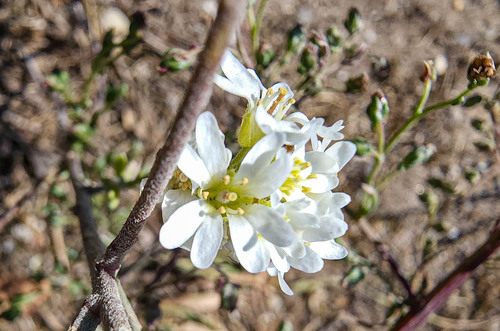
Overview
Berteroa is a small genus of herbaceous plants in the mustard family (Brassicaceae), native to Europe and temperate Asia. The most widespread species, Berteroa incana, called hoary alyssum, is an annual to short-lived perennial that has naturalized broadly across North America as a weed of fields, roadsides, and disturbed ground. Plants form erect, branching stems 8-32 inches (20-80 cm) tall, covered in dense grey star-shaped hairs that give the foliage a hoary, grey-green appearance. The narrow leaves are alternate and untoothed. From late spring through autumn, plants carry elongating racemes of small white flowers, each with four petals so deeply notched that they appear divided into eight. Flowering and seed set continue over a long season, producing flattened oval seed pods that scatter numerous seeds. Berteroa incana tolerates poor, dry, gravelly soils and full sun, which allows it to colonise degraded sites quickly. The species is of concern in pastures and hay because it is toxic to horses, causing illness when eaten in quantity, though it is not generally harmful to ruminant livestock.
Native Range
Native to Europe and temperate Asia on dry grassland, sandy soils, and disturbed ground. Berteroa incana has naturalized widely across North America, where it grows along roadsides, in pastures, and on waste ground.Suggested Uses
Berteroa is not grown as an ornamental and is chiefly significant as a naturalized weed of pastures and disturbed land. It is mainly encountered in the context of rangeland and roadside vegetation management.How to Identify
Appearance
Size & Dimensions
Height8" - 2'8"
Width/Spread6" - 1'4"
Colors
Flower Colors
Foliage Colors
Bloom Information
Detailed Descriptions
Foliage Description
Grey-greenGrowing Conditions
Sun Requirements
Requires 6-12 hours of direct sunlight daily
• Full Sun: 6+ hours of direct sunlight
• Partial Shade: 3-6 hours of direct sunlight
• Full Shade: Less than 3 hours of direct sunlight
Water & Climate
Water Needs
Drought Tolerance
Drought tolerant when established
