Batis, Genus, spp., Multiple species,
- Genus
- Multiple species
saltwort
Tropical and subtropical coasts of the Americas, Pacific, and Australasia
Overview
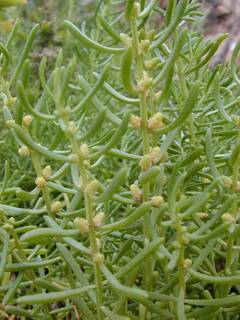
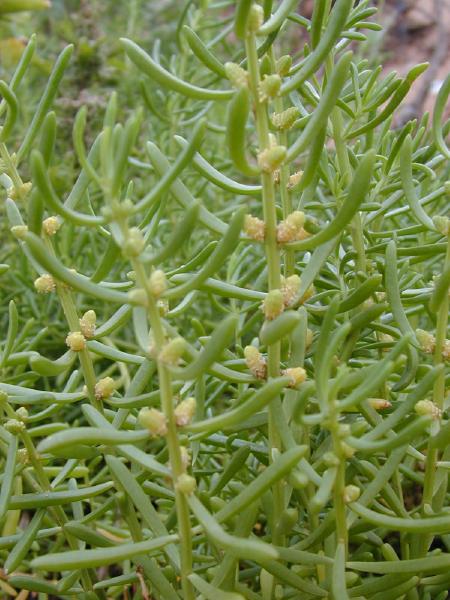
Batis is a small genus of sprawling, succulent, salt-tolerant subshrubs in the family Bataceae, comprising B. maritima of warm American and Pacific coasts and B. argillicola of New Guinea and northern Australia. Plants form low, much-branched, spreading mounds 1-4 feet (30-120 cm) tall and several feet across, rooting where the trailing stems touch wet ground. Leaves are opposite, fleshy, club-shaped, and yellow-green, 0.4-1 inch (1-2.5 cm) long, with a salty, slightly bitter taste. Plants are dioecious, bearing separate male and female individuals; the tiny flowers are massed in short, cone-like greenish spikes in the leaf axils. Female spikes ripen into fleshy, fused fruiting heads. Plants are evergreen in frost-free climates and grow moderately, spreading to form colonies on bare saline mud. The succulent stems and leaves store water and tolerate full-strength salt spray and periodic tidal flooding. Hard frost kills the soft growth.
Native Range
B. maritima is native to coastal tropical and subtropical America, from the southern United States through the Caribbean, Mexico, and Central and South America, and on Pacific islands including Hawaii. B. argillicola occurs in New Guinea and northern Australia. Plants grow in salt marshes, mangrove margins, tidal flats, and saline depressions, just above the regularly flooded zone.Suggested Uses
Planted for salt-marsh restoration, dune and shoreline stabilization, and revegetation of saline and brackish ground, spaced 2-3 feet (0.6-0.9 m) apart. The salty, succulent shoots of B. maritima are eaten raw or cooked as a coastal vegetable and seasoning. The sprawling habit forms dense ground cover on bare saline soil but needs salt and moisture to persist.How to Identify
Appearance
Size & Dimensions
Height1' - 4'
Width/Spread3' - 8'
Bloom Information
Flowering occurs through the warm season, mostly spring to autumn, and nearly year-round in frost-free tropical sites. The small greenish spikes are inconspicuous and wind- to insect-pollinated. Fleshy fruiting heads develop on female plants over summer and autumn.
Detailed Descriptions
Foliage Description
yellow-greenGrowing Conditions
Sun Requirements
Requires 6-12 hours of direct sunlight daily
• Full Sun: 6+ hours of direct sunlight
• Partial Shade: 3-6 hours of direct sunlight
• Full Shade: Less than 3 hours of direct sunlight
Care & Maintenance
Care Guide
Plants grow in full sun in wet, saline to brackish soils and tolerate salt spray, tidal flooding, and hypersaline mud that excludes most plants. They are used mainly in coastal restoration and saline-soil revegetation rather than ornamental gardens. Establishment is from cuttings or rooted stem pieces pressed into moist saline ground, where they spread by trailing, rooting stems. Plants are frost-tender, with soft growth killed below about 30 F (-1 C). Few pests trouble them in their salt-rich habitat. Growth slows in fresh water or non-saline soil, where competition from other plants increases.Pruning
Little pruning is required, as plants are grown for ground cover and coastal stabilization. Trailing stems can be cut back to contain spread or to remove frost-damaged growth. Cut stem pieces root readily and are used to start new plants.Pruning Schedule
spring