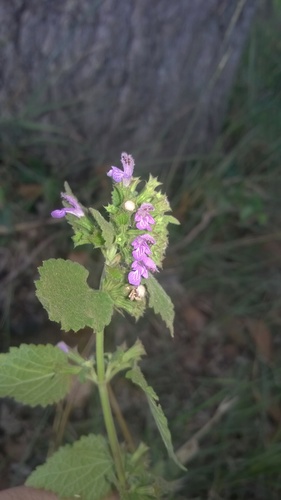
Ballota, Genus, nigra, Species,
- Genus & species
black horehound
Mediterranean basin, southern Europe, and western Asia from Portugal east to Iran
Overview
Ballota nigra is a bushy, semi-evergreen herbaceous perennial reaching 24–36 inches (60–90 cm) tall and 24–36 inches (60–90 cm) wide. Stems are square in cross-section (a character of the mint family Lamiaceae), upright to spreading, and densely covered with soft gray-green hairs. Leaves are opposite, ovate to heart-shaped, 1–2 inches (2.5–5 cm) long, gray-green, woolly-textured, and scalloped along the margins. The crushed foliage releases a strong, pungent, musky odor, the source of the common name stinking horehound. Two-lipped flowers 0.4–0.6 inch (10–15 mm) long are pale lilac to white and borne in whorled clusters in the leaf axils from June through September. The calyx is funnel-shaped with 5 broad rounded teeth that persist along the stems after the petals drop, forming dry seed cups through fall and winter. Growth is rapid, with plants reaching mature size in the first year from seed; stems become lax with age and give the plant a loose informal habit. Limitation: plants self-seed freely in well-drained soils and can spread into adjacent beds and waste ground in mild climates, and the strong odor of crushed foliage carries several feet in warm weather, so siting directly beside seating areas, paths, or entry doors will put the scent within close range of passersby.
Native Range
Native to the Mediterranean basin, southern Europe, and western Asia from Portugal east to Iran, occurring on roadsides, waste ground, stony slopes, and dry field margins from near sea level to 4,000 feet (1,200 m) elevation. Naturalized in parts of Britain, central Europe, and scattered locations in North America from garden escapes.Suggested Uses
Used in dry borders, gravel gardens, Mediterranean-style plantings, and herb garden collections at 24–36 inch (60–90 cm) spacing. The gray-green woolly foliage serves as a neutral background for brighter-flowered companions, and the persistent calyces carry into dried arrangements. Coastal plantings are tolerated because of the species' salt tolerance. Container culture is possible in pots of at least 5 gallons (19 L) with a freely draining mix.How to Identify
Appearance
Size & Dimensions
Height2' - 3'
Width/Spread2' - 3'
Bloom Information
Pale lilac to white two-lipped flowers 0.4–0.6 inch (10–15 mm) long appear in whorled clusters in the leaf axils from June through September. The funnel-shaped calyces with 5 broad rounded teeth persist along the stems after the petals drop, remaining into fall and winter. Self-sowing is prolific in well-drained soils.
Detailed Descriptions
Flower Description
pale lilac to white; two-lipped, 0.4-0.6 inch (10-15 mm) long, in whorled clusters in the leaf axilsFoliage Description
gray-green; opposite, ovate to heart-shaped, 1-2 inches (2.5-5 cm) long, woolly-textured with scalloped marginsGrowing Conditions
Sun Requirements
Requires 6-10 hours of direct sunlight daily
• Full Sun: 6+ hours of direct sunlight
• Partial Shade: 3-6 hours of direct sunlight
• Full Shade: Less than 3 hours of direct sunlight
Care & Maintenance
Care Guide
Site in full sun with 6–10 hours of direct sun per day in well-drained soil with a pH of 6.0–8.0. The species tolerates poor, rocky, alkaline, and chalky soils and salt spray in coastal sites. Overwatering and heavy wet soils cause root rot and stem collapse; clay soils without drainage amendment are unsuitable. Plants self-seed aggressively in mild climates and rapid regrowth can become weedy; removing spent flower and calyx stems before seed maturity controls spread. Fertilization is not required. Hardy in USDA zones 4–9.Pruning
Cut plants back by one-half to two-thirds in midsummer (July) to produce a second flush of compact fresh foliage and reduce self-sowing. Cut all stems to 2–4 inches (5–10 cm) above ground in early spring before new growth emerges. Spent flower and calyx stems can be removed before seed dispersal to limit self-sowing.Pruning Schedule
Prune: March & July
summerearly spring
Container Growing
Suitable for container growing
Minimum container size: 5 gallons