Baileya, Genus, spp., Multiple species,
- Genus
- Multiple species
desert marigold
Overview
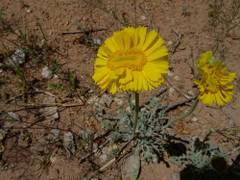
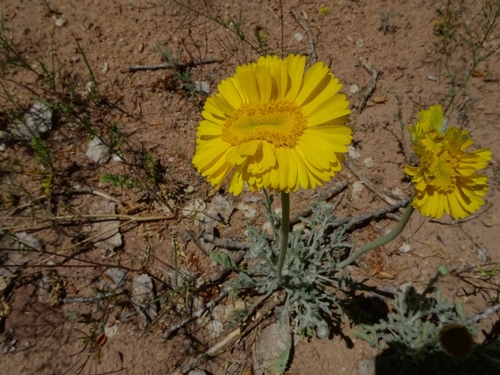
Baileya is a small genus of short-lived herbs in the sunflower family Asteraceae, native to the deserts of southwestern North America. Plants grow as annuals or short-lived perennials, forming low basal rosettes 6-18 inches (15-45 cm) tall and 8-16 inches (20-40 cm) wide. The stems and lobed, deeply cut leaves are densely covered in white woolly hairs, giving the foliage a grey to silvery cast that is concentrated near the base. Yellow flower heads 1-2 inches (2.5-5 cm) across are held singly on long, nearly leafless stalks well above the foliage; B. multiradiata carries 25-50 overlapping ray florets that fade to papery white with age. Flowering continues over a long season wherever soil moisture allows, often from spring into autumn. Plants reseed freely and behave as self-renewing colonies even when individual plants are short-lived. Growth is quick from seed, with flowering beginning within a few months. Foliage and stems are coarse and brittle.
Native Range
Native to the arid southwestern United States and northern Mexico, including the Mojave, Sonoran, and Chihuahuan deserts across California, Nevada, Arizona, New Mexico, and Texas. Plants grow on sandy and gravelly desert flats, roadsides, and disturbed ground from about 1,000 to 6,000 feet (300-1,800 m) elevation.Suggested Uses
Grown in desert and gravel gardens, rock gardens, and roadside or revegetation plantings, spaced 10-14 inches (25-35 cm) apart. The long bloom and self-sowing habit suit naturalistic dry plantings and wildflower mixes. Plants are short-lived and renew from seed rather than persisting as long-term specimens.How to Identify
Appearance
Size & Dimensions
Height6" - 1'6"
Width/Spread8" - 1'4"
Bloom Information
Flowering occurs over a long season, from March through October in the desert, peaking after spring and late-summer rains. Individual heads last 1-2 weeks, and plants flower repeatedly as long as some soil moisture is present. Bloom slows during the hottest, driest weeks and resumes after rain.
Detailed Descriptions
Foliage Description
grey-greenGrowing Conditions
Sun Requirements
Requires 6-12 hours of direct sunlight daily
• Full Sun: 6+ hours of direct sunlight
• Partial Shade: 3-6 hours of direct sunlight
• Full Shade: Less than 3 hours of direct sunlight
Care & Maintenance
Care Guide
Plants grow in full sun in fast-draining sandy or gravelly soil and fail in clay or watered garden beds. Established plants are highly drought-tolerant and bloom on natural rainfall, while extra irrigation causes soft, floppy growth and rot. Plants tolerate intense heat and reflected sun but are sensitive to prolonged frost. Seed germinates after rain, and colonies maintain themselves by self-sowing rather than long individual life. Few pests trouble the woolly foliage, though crown rot follows overwatering. Foliage and seeds contain compounds toxic to grazing sheep and goats.Pruning
Shear off spent flower stalks through the season to tidy plants and prolong blooming, though some seed heads can be left to allow self-sowing. Cut declining plants to the base or remove them entirely at season end. No structural pruning is needed on these low, short-lived plants.Pruning Schedule
summerfall
Container Growing
Suitable for container growing
Minimum container size: 2 gallons