Image 1 of 11
Plant Reference
1 / 11
Aspidistra, Genus, elatior, Species,
- Genus & species
cast iron plant
Japan and Taiwan; temperate-forest understory habitats with deep-shade exposure beneath broadleaf canopy trees, consistent year-round moderate temperatures, and well-drained organic forest-floor substrate.
Overview
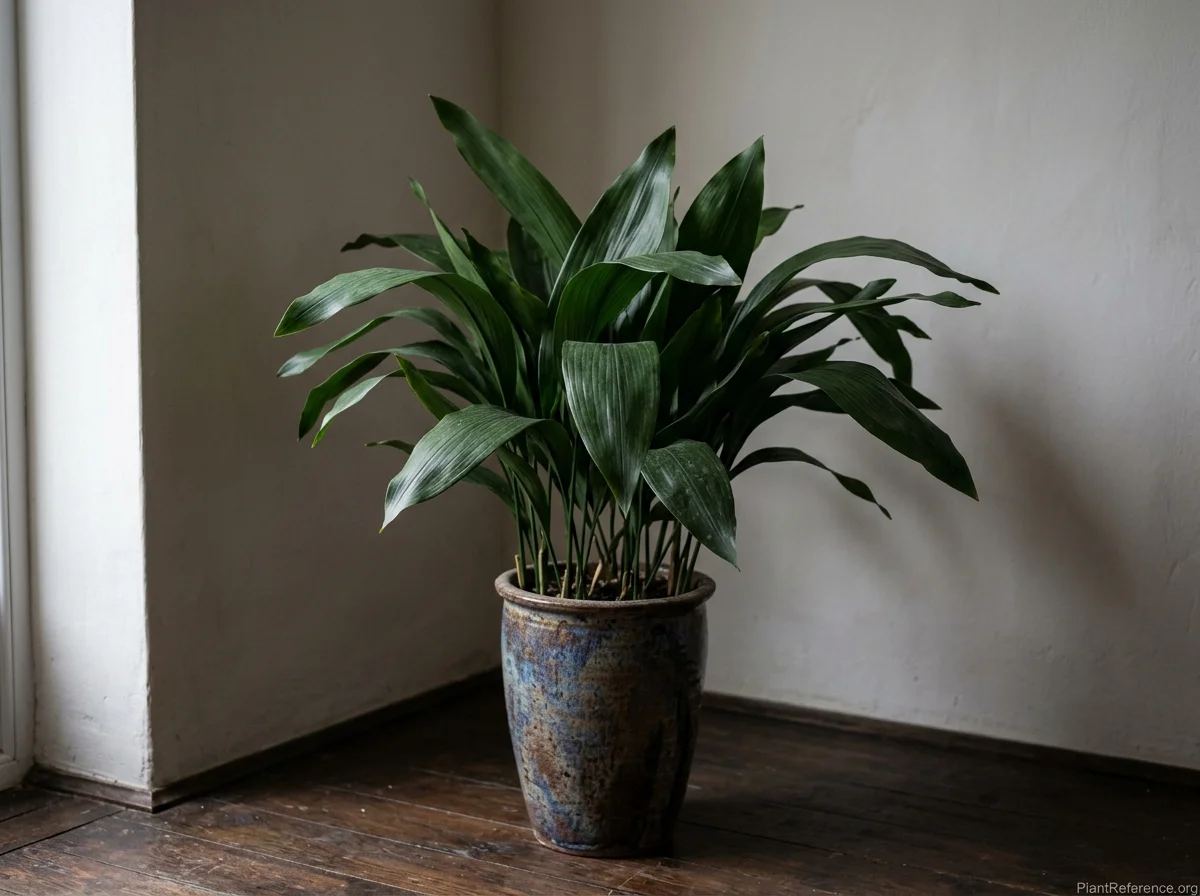
Aspidistra elatior is the cast iron plant (also called bar room plant), an evergreen perennial in the asparagus family (Asparagaceae, subfamily Nolinoideae) growing 18-24 inches (45-60 cm) tall and wide as an indoor houseplant or as an outdoor shade ground cover in mild-climate gardens. The species is among the more neglect-tolerant common indoor houseplants and the common name 'cast iron plant' is earned through the species' working reputation: the plant survives conditions including extended drought, deep shade or near-darkness, dust accumulation, low ambient humidity, irregular watering schedules, and broad temperature swings that would kill most other indoor plants. The alternate common name 'bar room plant' references the species' Victorian-era survival in gas-lit smoke-filled British and American taverns where the dim light, atmospheric pollution from gas combustion, and irregular watering of public-house plantings would have killed essentially any other ornamental species — the species' ability to survive these conditions made it the standard 19th-century indoor plant for low-maintenance commercial settings. The species' principal physical character is the dark green large broadly lance-shaped leathery upright leaves 12-20 inches (30-50 cm) long and 3-5 inches (7-15 cm) wide, each leaf carried individually on its own petiole emerging directly from the underground rhizome. The species does not produce stems in the conventional sense — what appears to be the stem of each leaf is the petiole running from the rhizome to the leaf blade — and the individually-petioled leaf-from-rhizome architecture is one of the species' principal field-identification characters at the foliage level. The clumping rhizomatous habit produces a slowly-expanding mounded form over years of growth in undisturbed plantings. Spring flowering produces small purple-brown bell-shaped flowers approximately 1 inch (2.5 cm) across at the soil-line interface, hidden by surrounding foliage and almost never noticed without active searching; the soil-level flower position reflects the species' natural pollination by slugs and fungus gnats in the Japanese forest-floor native habitat — the flowers are physically positioned where ground-dwelling pollinators encounter them rather than at canopy level where flying pollinators would be the principal visitors. The species' extreme shade tolerance reflects the temperate-forest understory native habitat: native to Japan and Taiwan in deep-shade understory positions beneath broadleaf canopy trees, the species evolved to photosynthesize at the very low light levels reaching the forest floor through the canopy, and the same physiological adaptation translates to the species' ability to survive the lowest indoor-light positions in temperate-zone houseplant cultivation. The species is one of relatively few common houseplants that doubles as an outdoor perennial in mild-climate gardens — hardy outdoors across zones 7-11 as a shade ground cover for woodland-garden and shaded urban garden positions where most ornamental ground covers struggle in the deep-shade conditions. Slow growth rate is a defining cultivation feature — the species produces only 2-4 new leaves per year in indoor cultivation and a mature 24-inch indoor specimen may be 5-10 years old; the slow growth balances against the essentially indestructible cultivation profile and the year-round ornamental contribution. The species is non-toxic to humans and pets, distinguishing the species from many other dark-green-foliaged houseplants in the Araceae and Asparagaceae families that carry calcium oxalate or saponin toxicity. Several variegated cultivars including 'Variegata' (white striped), 'Milky Way' (white spotted), and 'Asahi' (white-tipped) are available for gardeners who want a variegated foliage pattern beyond the standard dark green species type.
Native Range
Aspidistra elatior is native to Japan and Taiwan with a continuous native range across the southern Japanese islands (Kyushu, Shikoku, southern Honshu, and the Ryukyu archipelago including Okinawa) and the island of Taiwan. The species occurs in temperate-forest understory habitats beneath broadleaf canopy trees, in deep-shade positions with consistent year-round moderate temperatures, well-drained organic forest-floor substrate enriched by leaf litter, and sheltered conditions away from drying winds and direct sun exposure. The species has been introduced into ornamental cultivation broadly across temperate-zone gardens worldwide and is grown indoors as a low-maintenance houseplant in cold-climate zones (3-6) and outdoors as a shade ground cover in mild-climate gardens (zones 7-11) including the southeastern United States, coastal California, the Mediterranean basin, and other comparable mild-temperate climate zones.Suggested Uses
Used as a low-maintenance indoor houseplant in north-facing rooms, interior offices, hallways with no windows, low-light bathrooms, and other indoor positions where bright light is severely limited and most other houseplants cannot survive. The species is among the more neglect-tolerant common indoor houseplants and is grown by gardeners who want a reliable indoor foliage plant that survives extended absences, irregular watering, and minimal light without visible stress. The species is non-toxic to humans and pets, making it suitable for households with pets or children where ornamental-foliage toxicity is a concern. Outdoor cultivation as a shade ground cover in mild-climate gardens (zones 7-11) extends the species' design role beyond indoor houseplant use; the species is grown in shaded woodland-garden positions, beneath established trees and shrubs, and in shaded urban courtyards and entry-garden plantings where the dense shade and restricted air movement make most ornamental ground covers struggle. The species pairs with companion shade-tolerant plantings including Hosta cultivars, Helleborus (hellebores), Heuchera (coral bells), Carex sedges, and Tiarella (foamflower) for outdoor shade-garden compositions where the Aspidistra dark green leathery leaves contribute a textural and structural contrast against the lighter and more delicate companion foliage. The species carries cultural and historical significance as the standard 19th-century Victorian indoor plant for gas-lit interiors — the cast iron plant was the workhorse houseplant of Victorian commercial settings (taverns, hotel lobbies, railway waiting rooms) and the species has remained a working low-maintenance houseplant choice across the subsequent 150+ years of changing horticultural fashion.How to Identify
Appearance
Size & Dimensions
Height1'6" - 2'
Width/Spread1'6" - 2'
Colors
Bloom Information
Small purple-brown bell-shaped flowers approximately 1 inch (2.5 cm) across appear at the soil-line interface in spring (March-April) across a 2-week active flowering window. The flowers are physically positioned at ground level beneath the surrounding foliage canopy and are hidden by the leaves — the flowers are almost never noticed in indoor cultivation without active searching. The soil-level flower position reflects the species' natural pollination by slugs and fungus gnats in the Japanese forest-floor native habitat — the flowers are physically positioned where ground-dwelling pollinators encounter them rather than at canopy level where flying pollinators (bees, butterflies) would be the principal visitors, and the slug-and-fungus-gnat pollination system is itself an interesting natural-history teaching point for the species in educational and botanical-collection plantings.
Detailed Descriptions
Flower Description
Purple-brown to maroonFoliage Description
Dark green; large broadly lance-shaped leathery upright leaves 12-20 inches (30-50 cm) long and 3-5 inches (7-15 cm) wide, each leaf carried individually on its own petiole emerging directly from the underground rhizome (the species does not produce stems; what appears to be the stem of each leaf is the petiole running from the rhizome to the leaf blade), and the individually-petioled leaf-from-rhizome architecture is one of the species' principal field-identification characters at the foliage levelGrowing Conditions
Sun Requirements
Requires 1-4 hours of direct sunlight daily
• Full Sun: 6+ hours of direct sunlight
• Partial Shade: 3-6 hours of direct sunlight
• Full Shade: Less than 3 hours of direct sunlight
Care & Maintenance
Care Guide
Place in low to medium indirect light — the species tolerates the lowest indoor-light conditions of any common foliage houseplant and survives in north-facing rooms, interior offices, hallways with no windows, and other extreme low-light positions where most ornamental plants cannot photosynthesize at maintenance levels. The species also tolerates brighter indirect light without difficulty but does not require direct sun and is damaged by intense direct afternoon sun in indoor settings. Water when the top 1-2 inches (2.5-5 cm) of soil dries to the touch — the species tolerates extended drought between waterings and over-watering is far more dangerous than under-watering for the species. Many gardeners water the species only every 2-3 weeks during active growth and every 4-6 weeks during winter months. Well-draining substrate at pH 5.5-7.5 supports the species reliably. Fertilization is at half-strength every 2-3 months during the active growing season (spring through summer); the species does not require heavy fertilization and excessive fertilizer can damage the rhizome system. Wipe the leaves periodically with a damp cloth to remove dust accumulation that reduces both light absorption and the foliage gloss. The slow indoor growth rate (2-4 new leaves per year) means the species rarely needs repotting more than every 3-5 years; over-frequent repotting disturbs the rhizome system without benefit. Hardy outdoors across zones 7-11 as a shade ground cover; in cold zones (3-6) the species is grown indoors in 5-gallon (19-liter) or larger pots. The species is non-toxic to humans and pets, distinguishing it from many other dark-foliaged houseplants that carry toxicity concerns.Pruning
Remove damaged or browned leaves at the petiole-rhizome attachment point at the soil line. The species does not benefit from active pruning for shape or growth control because the slow growth rate (2-4 new leaves per year under indoor conditions) means active pruning is rarely needed. The clumping rhizomatous habit can be divided every 5-10 years if a single specimen has expanded to fill its container or planting position; division is in spring before new growth resumes, with the rhizome cut into sections each carrying 3-5 leaves and an active growing point.Container Growing
Suitable for container growing
Minimum container size: 5 gallons