Aristida, Genus, spp., Multiple species,
- Genus
- Multiple species
threeawns and wiregrasses
Warm regions worldwide; many species in the Americas, Africa, and Australia
Overview
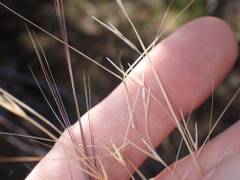
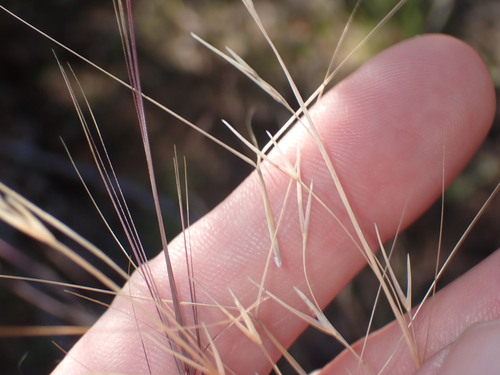
Aristida is a genus of about 300 warm-season grasses in the family Poaceae, found in dry, open habitats across the warmer parts of every inhabited continent. Most species are tufted bunchgrasses 0.5-3 ft (15-90 cm) tall, forming narrow clumps of wiry, often inrolled leaf blades 2-12 inches (5-30 cm) long. The flowering panicles are narrow to open, 4-12 inches (10-30 cm) long, carrying slender spikelets whose defining feature is a lemma tipped with three awns 0.3-3 inches (0.8-8 cm) long. These three-pronged awns twist when wet, drilling the sharp-pointed seed into soil and into the coats and mouths of grazing animals, which limits the forage value of the genus. Plants grow actively in the warm season and cure to straw and pale gold as they dry. Members of Aristida colonize sandy soils, eroded banks, overgrazed range, and roadsides, often increasing where heavier grazing has thinned more palatable grasses. Lifespan ranges from annual to long-lived perennial, and cold tolerance varies with origin.
Native Range
Distributed through the tropics, subtropics, and warm temperate zones worldwide, with many species native to the grasslands, deserts, and pinelands of the Americas, Africa, and Australia. Wiregrass (A. stricta and A. beyrichiana) is native to the longleaf pine savannas of the southeastern United States.Suggested Uses
Used in habitat restoration, erosion control on sandy banks, and prairie and pineland plantings, with wiregrass being central to longleaf pine savanna restoration in the southeastern United States. The wiry clumps and airy seed heads suit naturalistic and dry-garden plantings. Most species carry low forage value and are managed on rangeland rather than sown for grazing.How to Identify
Appearance
Size & Dimensions
Height6" - 3'
Width/Spread6" - 2'
Bloom Information
Most species flower from late summer into autumn (August-November), with some producing a second flush after warm-season rain. The narrow panicles emerge above the foliage and dry to pale straw as the awned seeds mature. Wind handles pollination, and the barbed seeds disperse on animal coats.
Detailed Descriptions
Flower Description
Green to strawFoliage Description
Green to gray-greenGrowing Conditions
Sun Requirements
Requires 6-12 hours of direct sunlight daily
• Full Sun: 6+ hours of direct sunlight
• Partial Shade: 3-6 hours of direct sunlight
• Full Shade: Less than 3 hours of direct sunlight