Antigonon, Genus, spp., Multiple species,
- Genus
- Multiple species
coral vine
Overview
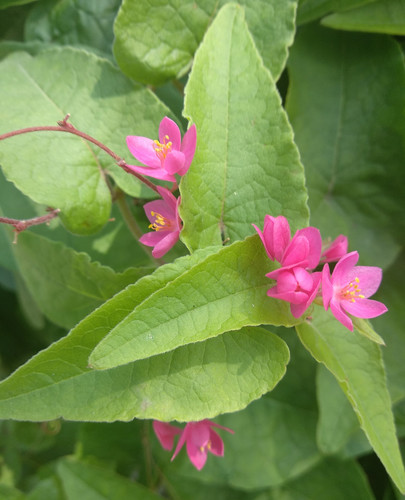
Antigonon is a genus of tuberous-rooted perennial climbers in the buckwheat family Polygonaceae, native to Mexico and Central America and containing about three species. Stems climb by branched tendrils borne at the tips of the flower clusters, reaching 20-40 feet (6-12 m) in a single season where frost is absent. The leaves are heart-shaped to arrowhead-shaped, 2-5 inches (5-13 cm) long, with a crinkled surface and prominent veins. From late spring until autumn the vines carry open sprays of small flowers, each surrounded by five petal-like sepals 0.25-0.5 inch (6-12 mm) wide in pink, rose-red, or, in some forms, white. The true flowers are tiny, while the colored structures persist and turn papery as the seed develops within. A. leptopus, the species grown most often, spreads by both seed and brittle tubers and has naturalized across many tropical regions, where it can smother supporting vegetation. The genus dies back to its tubers after frost and resprouts when warmth returns, behaving as a herbaceous perennial at the cool edge of its range and as an evergreen in frost-free climates. The roots are swollen and starchy, allowing plants to survive drought and periodic cutting. Honeybees work the flowers heavily, and in parts of the tropics the genus is grown as a nectar source.
Native Range
Native to Mexico and Central America. Plants grow in tropical dry forest, thickets, and disturbed open ground, scrambling over rocks, shrubs, and fences.Suggested Uses
Antigonon is grown to cover fences, pergolas, arbors, and trellises and to give quick warm-season screening. The nectar-rich flowers draw bees, butterflies, and hummingbirds through summer. In containers the genus is trained as a climber that can be cut back and overwintered under cover in cold regions.How to Identify
Appearance
Size & Dimensions
Height20' - 40'
Width/Spread3' - 10'
Bloom Information
Flowering begins in late spring and continues until the first frost, peaking in the heat of summer. In frost-free regions the vines flower nearly year-round in flushes tied to rainfall. Each spray opens its outer sepals over several days, and the colored sepals remain on the plant for weeks as the seed matures.
Detailed Descriptions
Flower Description
pink to rose-redFoliage Description
greenGrowing Conditions
Sun Requirements
Requires 6-10 hours of direct sunlight daily
• Full Sun: 6+ hours of direct sunlight
• Partial Shade: 3-6 hours of direct sunlight
• Full Shade: Less than 3 hours of direct sunlight
Care & Maintenance
Care Guide
Plants grow fastest in full sun and warm conditions, in well-drained soil of moderate fertility with a pH near 6.0 to 7.5. Once the tubers are established the genus tolerates extended drought and poor, rocky ground, though growth and flowering slow without summer moisture. Hardy outdoors in USDA zones 8 to 11, the top growth is killed near 32F (0C) but resprouts from the tuber where the ground does not freeze deeply. A sturdy trellis, fence, or arbor supports the climbing stems, which can reach the top of their support in one season. Propagation is by seed, tuber division, or softwood cuttings taken in summer. In tropical climates the genus can spread aggressively and is treated as a weed where it escapes cultivation.Pruning
Stems can be cut back hard in late winter or early spring before new growth begins, which the tubers tolerate well. Removing seed heads before they ripen limits self-sowing in frost-free regions where the genus naturalizes. Tangled or frost-killed growth is cleared to the base each spring.Container Growing
Suitable for container growing
Minimum container size: 5 gallons
