Anticlea, Genus, spp., Multiple species,
- Genus
- Multiple species
death camas
Western and central North America; northeastern Asia
Overview
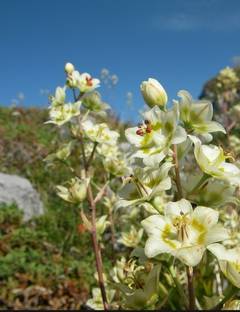
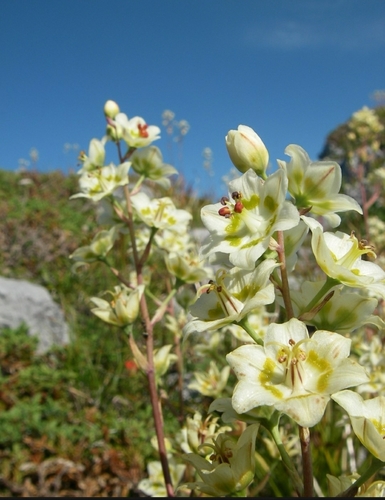
Anticlea is a genus of bulbous perennials in the family Melanthiaceae, comprising roughly 10 to 12 species formerly placed in Zigadenus. Plants grow from a tunicated bulb and produce a tuft of narrow, grass-like basal leaves 8-16 inches (20-40 cm) long with smooth margins and parallel veins. Flowering stems rise to 8-28 inches (20-70 cm), carrying branched panicles or unbranched racemes of small, star-shaped flowers. Individual flowers measure 0.2-0.4 inch (5-10 mm) across, with six tepals in shades of cream, greenish-white, or pale yellow, each marked with a basal gland. The genus is distributed across western and central North America and parts of northeastern Asia, where it occupies mountain meadows, rocky slopes, and seasonally moist grassland. All parts contain steroidal alkaloids including zygacine, and ingestion can be fatal to grazing animals and people. Species vary in habit, with A. elegans forming open colonies at high elevation and A. occidentalis favoring wet streambanks. Flowering occurs from late spring into summer depending on elevation and latitude, after which the foliage dies back and the bulb rests through dry or cold periods. Because the leaves resemble those of edible wild onions but lack any onion odor, the genus is a frequent cause of accidental poisoning in foraging.
Native Range
Native to western and central North America and northeastern Asia. Species occur in mountain meadows, sagebrush slopes, and seasonally wet grassland, from lowland prairie to alpine elevations.Suggested Uses
Anticlea is grown in rock gardens, native-plant meadows, and naturalistic plantings where its early flowers precede summer dormancy. The genus is also used in restoration of montane and prairie habitats within its native range. Its toxicity makes it unsuited to plantings accessible to livestock.How to Identify
Appearance
Size & Dimensions
Height8" - 2'4"
Width/Spread4" - 10"
Bloom Information
Flowering runs from late spring through midsummer, typically May to July, shifting later at higher elevations. Each stem produces dozens of small flowers that open progressively from the base upward over two to three weeks. Three-chambered capsules follow and split to release angular seeds by late summer.
Detailed Descriptions
Flower Description
cream to greenish-yellowFoliage Description
green to grey-greenGrowing Conditions
Sun Requirements
Requires 4-8 hours of direct sunlight daily
• Full Sun: 6+ hours of direct sunlight
• Partial Shade: 3-6 hours of direct sunlight
• Full Shade: Less than 3 hours of direct sunlight