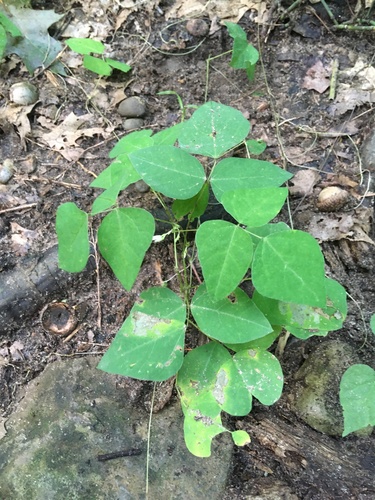
Amphicarpaea, Genus, spp., Multiple species,
- Genus
- Multiple species
hog peanut
Eastern North America, East Asia, and parts of Africa
SunPart Shade – Full Shade
WaterMedium
Overview
Amphicarpaea is a genus of about three species of twining annual and short-lived perennial legumes in the family Fabaceae, native to eastern North America, East Asia, and tropical Africa. Plants produce slender climbing stems 1-5 ft (0.3-1.5 m) long that twine over surrounding vegetation, bearing alternate trifoliate leaves with broadly ovate leaflets 0.8-3 in (2-8 cm) long. The genus is amphicarpic, producing two kinds of flowers. Aerial flowers are pea-shaped, pale purple to white, 0.3-0.6 in (8-15 mm) long, and borne in small clusters from the upper leaf axils in summer. Separate self-pollinating flowers form at or below ground level and develop fleshy single-seeded pods just under the soil surface, the structures that give the North American A. bracteata its common name hog peanut. Aerial pods are flat, curved, and contain three to four seeds. Stems and leaves die back at the end of the growing season. The genus fixes atmospheric nitrogen through root nodules and grows in moist woodland, thickets, and stream margins. Dense twining growth can smother low herbaceous plants.
Native Range
Amphicarpaea is native to eastern North America, East Asia, and parts of tropical and southern Africa. The most widespread species, A. bracteata, ranges across eastern Canada and the eastern United States.Suggested Uses
Amphicarpaea is grown in woodland and native-plant plantings, naturalised shade gardens, and habitat restoration. The underground seeds are eaten by small mammals and ground-feeding birds, and the foliage serves as larval food for some sulphur butterflies.How to Identify
Appearance
Size & Dimensions
Height1' - 5'
Bloom Information
Aerial pea-shaped flowers open from midsummer into early autumn (roughly July-September in the Northern Hemisphere), pale purple to white and clustered in the upper leaf axils. Self-pollinating basal flowers form over the same period and mature into underground pods. Flowering ends as the foliage dies back with the first frosts.
Detailed Descriptions
Flower Description
pale purple to whiteFoliage Description
greenGrowing Conditions
Sun Requirements
• Full Sun: 6+ hours of direct sunlight
• Partial Shade: 3-6 hours of direct sunlight
• Full Shade: Less than 3 hours of direct sunlight
Water & Climate
Water Needs
