Amelanchier, Genus, alnifolia, Species,
- Genus & species
serviceberry
Alaska and the Yukon south through British Columbia, Washington, and Oregon, east across the Rocky Mountains and Great Plains to Ontario; open forests, forest edges, rocky slopes, and streambanks
Overview
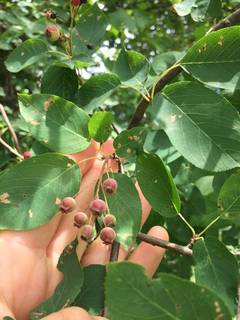
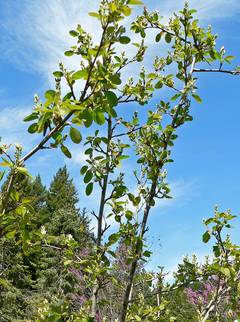
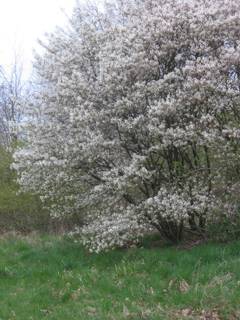
Amelanchier alnifolia is Saskatoon serviceberry (western serviceberry), an upright deciduous shrub or small tree growing 6-20 feet (1.8-6 m) tall and 6-15 feet (1.8-4.5 m) wide. White lightly fragrant 5-petaled flowers 0.75-1 inch (2-2.5 cm) form in erect racemes of 3-20 in April-May, before or with the emerging leaves; bloom lasts about 3 weeks. Sweet edible purple-black berries 0.25-0.5 inch (6-13 mm) ripen in June-July. New leaves emerge bronze-tinged, mature to mid-green, and turn orange to red and gold in fall. Family Rosaceae; the species epithet alnifolia means alder-leaved, referring to the alder-like leaf shape. Saskatoon serviceberry has been an important Indigenous food plant across the northern Plains and Pacific Northwest for thousands of years; berries are used fresh, dried, or pounded with bison meat and fat into pemmican, the original North American trail food. Documented by Lewis and Clark in 1805. The city of Saskatoon, Saskatchewan, is named for this plant. Native to Alaska and the Yukon south through British Columbia, Washington, and Oregon, east across the Rocky Mountains and Great Plains to Ontario. Cold-hardy to zone 3 (-40°F / -40°C). Drought-tolerant once established. Susceptible to cedar-serviceberry rust (Gymnosporangium), which alternates with Juniperus hosts; planting distant from junipers reduces infection. The compact cultivar 'Regent' grows 4-6 feet (1.2-1.8 m) tall. Berries feed 40+ bird species. Non-toxic. Hardy in zones 3-8. Grown in full sun to partial shade. Growth rate is moderate.
Native Range
Native to Alaska and the Yukon south through British Columbia, Washington, and Oregon, east across the Rocky Mountains and Great Plains to Ontario. Found in open forests, forest edges, rocky slopes, and streambanks. The city of Saskatoon, Saskatchewan, is named for this plant.Suggested Uses
Amelanchier alnifolia is grown as a native edible shrub or small tree in mixed borders, hedgerows, wildlife gardens, and Indigenous food gardens, spaced 6-15 feet (1.8-4.5 m) apart. Berries are edible and feed 40+ bird species. Cedar-serviceberry rust occurs where Juniperus alternate hosts are present. Non-toxic. Hardy in zones 3-8.How to Identify
Appearance
Size & Dimensions
Height6' - 20'
Width/Spread6' - 15'
Bloom Information
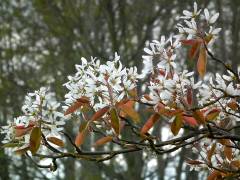
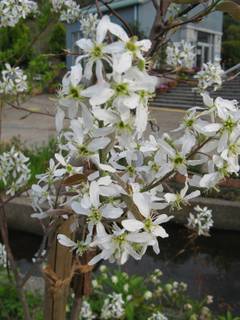
Spring (April-May). White lightly fragrant 5-petaled flowers 0.75-1 inch (2-2.5 cm) form in erect racemes of 3-20 for about 3 weeks. Blooms early in the spring season while many native shrubs remain dormant; visited by bees, butterflies, and hummingbirds. Sweet edible purple-black berries follow in June-July.
Detailed Descriptions
Flower Description
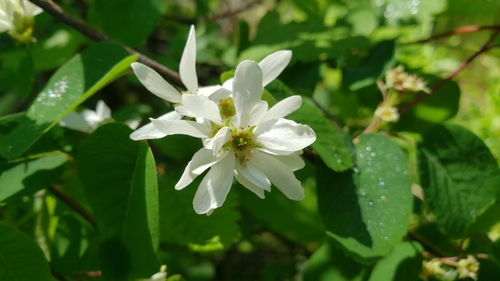
White, 5-petaled, lightly fragrant, 0.75-1 inch (2-2.5 cm), in erect racemes of 3-20 flowers; appear before or with the emerging leaves in April-May; bloom early in the spring season while many native shrubs remain dormant.Foliage Description
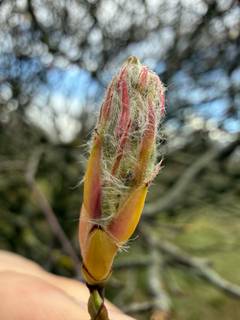
Bronze-tinged on emergence, maturing to mid-green; ovate to nearly round, with serrations on the upper half only (alnifolia = alder-leaved, referring to the Alnus-like leaf shape); turns orange to red and gold in fall.Growing Conditions
Sun Requirements
Requires 3-8 hours of direct sunlight daily
• Full Sun: 6+ hours of direct sunlight
• Partial Shade: 3-6 hours of direct sunlight
• Full Shade: Less than 3 hours of direct sunlight
Care & Maintenance
Care Guide
Grown in full sun to partial shade with 3-8 hours of direct sun. Soil tolerates clay, sand, rocky, or loam with a pH of 5.5-7.0. Drought-tolerant once established. Cold-hardy to zone 3 (-40°F / -40°C). Susceptible to cedar-serviceberry rust (Gymnosporangium), which alternates with Juniperus hosts; planting distant from junipers reduces infection. Berries are non-toxic and edible; the species is an important Indigenous food plant. Hardy in zones 3-8.Pruning
Pruned in early spring (February-March) before bud break. The oldest stems are cut to the base every few years to rejuvenate the clump. Light shaping is well-tolerated. The natural multi-stem upright form is the typical goal.Pruning Schedule
Prune: February–March
early spring