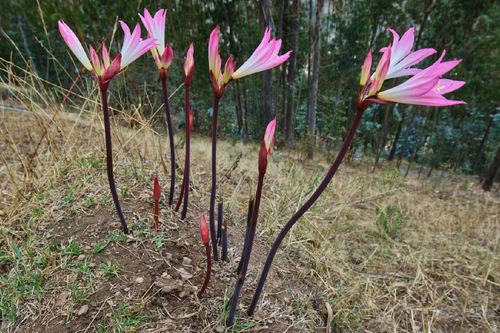
Amaryllis, Genus, belladonna, Species,
- Genus & species
belladonna lily
Overview
Amaryllis belladonna is a bulbous perennial reaching 18–30 inches (45–75 cm) tall in bloom, growing from a large, pear-shaped bulb 3–5 inches (8–13 cm) in diameter. The common name 'Naked Lady' refers to the leafless flower stalks that emerge from bare ground in late summer. Strap-shaped basal leaves 12–18 inches (30–45 cm) long and 1–2 inches (2.5–5 cm) wide appear in fall or winter (after flowering), persist through spring, and die back by early summer. Flower stalks are stout, solid, 18–30 inches (45–75 cm) tall, bearing terminal umbels of 6–12 funnel-shaped flowers. Flowers are 3–4 inches (8–10 cm) long, pink (ranging from pale shell-pink to deep rose-pink), and fragrant with a sweet scent. Bloom occurs August through September. Plants are slow to establish and may not flower until 3–5 years after planting; bulbs that are disturbed by transplanting may require 2–3 additional years before blooming. Bulbs multiply slowly by offsets. Bulb rot develops in wet summer soils. The reversed growth cycle (leaves in winter, flowers in summer, dormancy in between) limits compatibility with perennials that share the same space. All parts contain lycorine and are toxic if ingested. This is the true Amaryllis, distinct from the commonly sold indoor 'amaryllis' which belongs to the genus Hippeastrum.
Native Range
Native to the Western Cape of South Africa, found on rocky slopes, road cuts, and disturbed ground in a Mediterranean climate with wet winters and dry summers. Grows at 300–3,000 feet (100–900 m) elevation.Suggested Uses
Commonly planted along south-facing walls, in dry borders, and in Mediterranean-style gardens at 8–12 inch (20–30 cm) spacing. The reversed growth cycle pairs well with summer-dormant companions. Container culture in 5-gallon (19 L) or larger pots extends the usable range into zone 6 with frost-free winter storage. Not suited to cold-winter climates without protection, irrigated summer beds, or mixed borders where the bare-ground dormancy period in early summer is not acceptable.How to Identify
Appearance
Size & Dimensions
Height1'6" - 2'6"
Width/Spread8" - 1'
Bloom Information
Detailed Descriptions
Flower Description
Pink, from pale shell-pink to deep rose-pinkFoliage Description
Medium green, strap-shaped, basalGrowing Conditions
Sun Requirements
Requires 6-12 hours of direct sunlight daily
• Full Sun: 6+ hours of direct sunlight
• Partial Shade: 3-6 hours of direct sunlight
• Full Shade: Less than 3 hours of direct sunlight
Care & Maintenance
Care Guide
Plant bulbs with the neck at or just above the soil surface in a warm, sunny, south-facing site. Bulbs require dry summer dormancy (June–August) and tolerate winter rain. Do not irrigate during summer dormancy. Water during the winter–spring foliage period if rainfall is insufficient. Bulbs are slow to establish and resent disturbance; avoid transplanting established clumps. In zone 7, plant against a south-facing wall for thermal protection and apply 2–3 inches (5–8 cm) of winter mulch. Narcissus bulb fly may attack bulbs in some regions. All parts are toxic.Pruning
Remove spent flower stalks at the base after bloom in September. Allow strap-shaped winter/spring foliage to yellow and die back naturally in late spring (May–June); do not cut green leaves. No other pruning required.Pruning Schedule
Prune: June
summer
Container Growing
Suitable for container growing
Minimum container size: 5 gallons