Overview
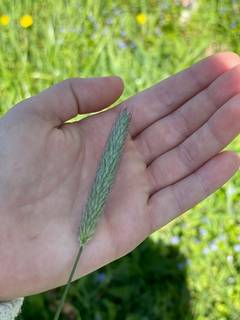
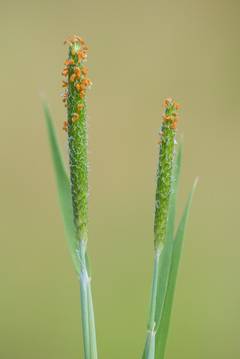
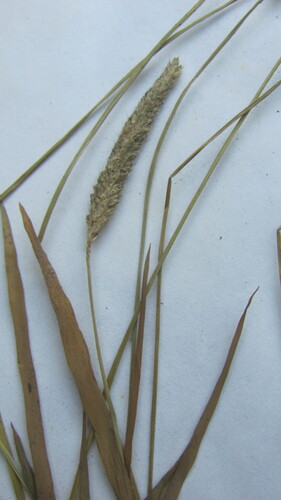
Alopecurus geniculatus is a low, tufted to spreading perennial grass, with stems 4-16 inches (10-40 cm) long that bend sharply at the lower joints and often root where they touch wet ground. The flat, grey-green leaves are 1-4 inches (2.5-10 cm) long with rough margins. The flower head is a soft, cylindrical, spike-like panicle 1-3 inches (2.5-8 cm) long, blunt at both ends, carrying many tiny flowers with protruding orange to purple anthers in early summer. The whole head feels velvety and bends easily. Plants form loose patches in wet, open ground and tolerate periodic flooding and trampling. Growth runs from spring through summer, with the foliage dying back over winter. It is short in stature and unable to compete in tall, dense vegetation.
Native Range
Found through Europe, much of Asia, North Africa, and North America, and naturalised more widely. Grows in wet meadows, pond and ditch margins, flood hollows, trampled gateways, and other damp, open ground, mainly in the lowlands.Suggested Uses
Used in wet meadow and pond-margin seed mixes, flood-tolerant grassland, and wetland restoration on damp, heavy ground. It binds soft, wet soil and tolerates trampling at water edges. Its low stature and need for wet ground limit its use in ornamental or dry plantings.How to Identify
Appearance
Size & Dimensions
Height4" - 1'4"
Width/Spread8" - 1'6"
Colors
Bloom Information
Flowers from May to July, with the anthers showing orange to purple as the head matures. Flowering can continue sporadically into late summer on damp ground. Heads ripen and shed seed over several weeks. Timing shifts with water levels and is later on cold, exposed sites.
Detailed Descriptions
Flower Description
green with orange to purple anthersFoliage Description
grey-greenGrowing Conditions
Sun Requirements
Requires 6-12 hours of direct sunlight daily
• Full Sun: 6+ hours of direct sunlight
• Partial Shade: 3-6 hours of direct sunlight
• Full Shade: Less than 3 hours of direct sunlight