Image 1 of 13
1 / 13
Plant Reference
Akebia, Genus, quinata, Species,
- Genus & species
five-leaved akebia
Japan, Korea, and central and eastern China; forest margins, thickets, and stream banks at low to moderate elevations
Overview
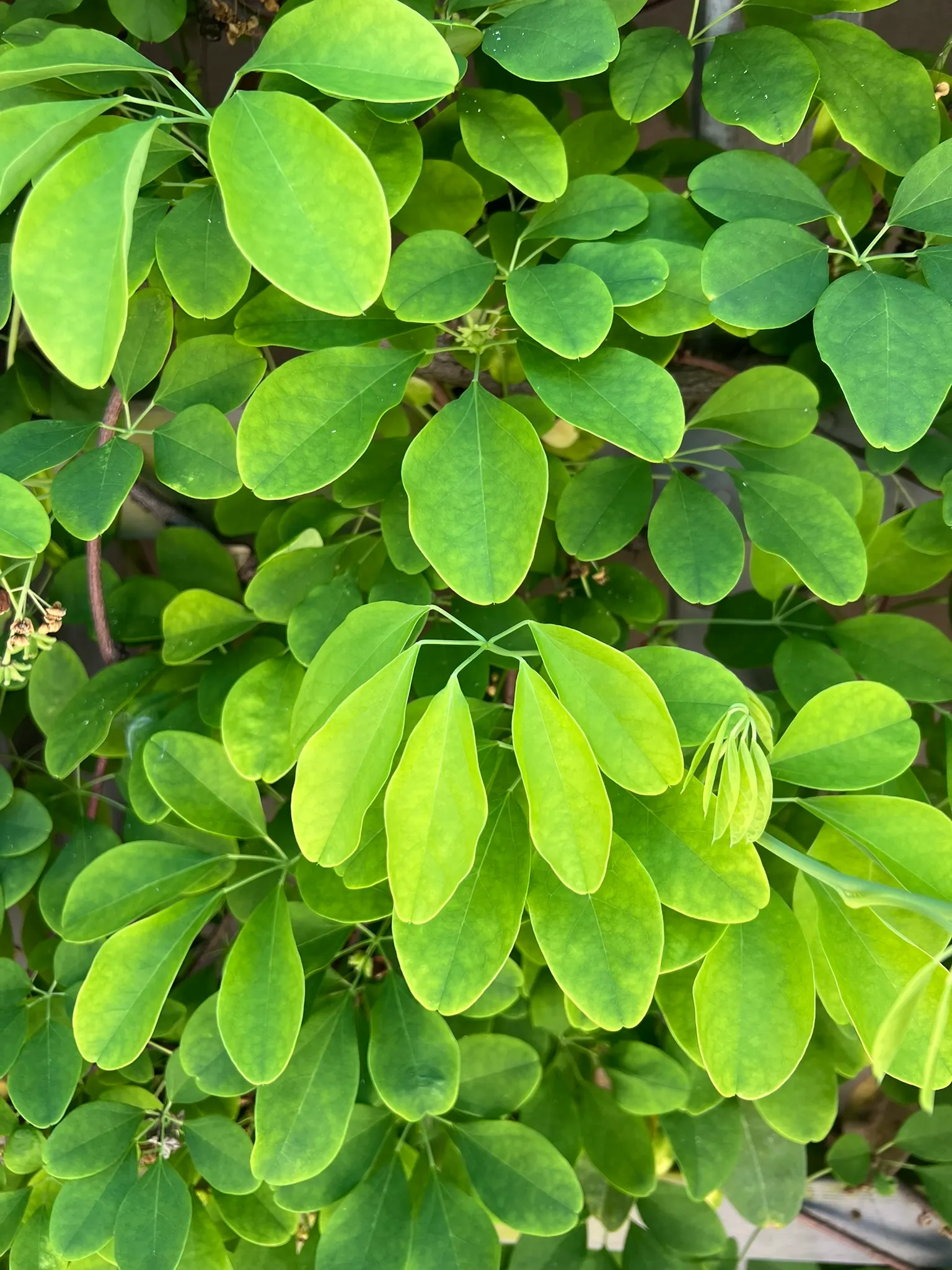
Akebia quinata is a semi-evergreen to deciduous twining vine in the family Lardizabalaceae, reaching 20-40 feet (6-12 m) in length with a spread of 6-10 feet (1.8-3 m). Leaves are palmately compound with 5 elliptical smooth-edged leaflets, each 1.5-2.5 inches (4-6 cm) long, medium blue-green above and carried on slender petioles. In mild Pacific Northwest winters (zones 7-9) the foliage persists through winter or drops briefly during cold snaps, while in colder zones the plant is fully deciduous. In March and April, vanilla-scented flowers open in hanging racemes — female flowers are larger, dark maroon-purple, 0.75-1 inch (2-2.5 cm) across, and male flowers are smaller, rose-purple, 0.25-0.5 inch (6-12 mm) across, with both sexes borne on the same raceme. Fruit are sausage-shaped grayish-purple pods 2-4 inches (5-10 cm) long containing sweet edible pulp around the seeds; fruit set requires cross-pollination between two genetically distinct plants, so a single cultivar rarely sets fruit. Growth is fast at 10-20 feet (3-6 m) per season once established. The vine climbs by twining without tendrils and can engulf and smother shrubs, small trees, and light support structures if left unmanaged. The species is classified as invasive in several eastern U.S. states including Kentucky, Maryland, Virginia, and Pennsylvania, and has naturalized in disturbed riparian areas across the Pacific Northwest — close monitoring and containment are the operating responsibilities for gardeners in these regions.
Native Range
Akebia quinata is native to Japan, Korea, and central and eastern China, where it grows in forest margins, thickets, and stream banks at low to moderate elevations. The species was introduced to Europe in the 19th century and to North America as an ornamental vine, and has since escaped cultivation and become naturalized or classified as invasive in several regions of eastern North America and the Pacific Northwest.Suggested Uses
Planted on trellises, pergolas, fences, and arbors in contained garden settings where the scented spring flowers and edible fruit are wanted. Shade tolerance separates it from most other flowering vines, and the species performs on north-facing structures where Clematis, Wisteria, and Lonicera struggle. Combined with deciduous structural vines such as Parthenocissus tricuspidata on the same support for complementary seasonal interest in zones 4-9. Not suited to positions near natural areas, forest edges, or riparian corridors where seedling escape and naturalization are documented concerns, or to jurisdictions where the species is prohibited as invasive. Fruit is edible when fully ripe but a second genetically distinct plant is required for fruit production.How to Identify
Appearance
Size & Dimensions
Height20' - 40'
Width/Spread6' - 10'
Bloom Information
Vanilla-scented flowers open on hanging racemes from March through April in zones 4-9, averaging 2-3 weeks of bloom. Female flowers are dark maroon-purple and 0.75-1 inch (2-2.5 cm) across; male flowers are rose-purple and 0.25-0.5 inch (6-12 mm) across, with both sexes carried on the same raceme. Fruit set requires cross-pollination between two genetically distinct plants, so a single cultivar rarely produces fruit in isolation. Grayish-purple fruit pods 2-4 inches (5-10 cm) long ripen from September through October on pollinated flowers.
Detailed Descriptions
Flower Description
dark maroon-purple (female flowers 0.75-1 inch / 2-2.5 cm) and rose-purple (male flowers 0.25-0.5 inch / 6-12 mm); vanilla-scented; borne in the same hanging racemesFoliage Description
blue-green to medium green year-round in mild climates; palmately compound leaves with 5 elliptical smooth-edged leaflets 1.5-2.5 inches (4-6 cm) long on slender petiolesGrowing Conditions
Sun Requirements
Requires 2-8 hours of direct sunlight daily
• Full Sun: 6+ hours of direct sunlight
• Partial Shade: 3-6 hours of direct sunlight
• Full Shade: Less than 3 hours of direct sunlight
Care & Maintenance
Care Guide
Plant in well-drained soil with a pH of 5.5-7.0 in part shade to part sun; tolerated soil types include loam, sand, and silt. A sturdy trellis, fence, arbor, or other support is installed at planting because the twining stems exert significant pressure on lightweight supports once established. Water weekly through the first 2 growing seasons; established vines tolerate moderate drought. Shade tolerance allows placement on north- or east-facing structures where few other flowering vines bloom reliably. Annual pruning is required to keep the vine from overwhelming its support or spreading into adjacent plantings. Positions near forest margins, stream banks, or natural areas are not suited to the species because of its documented escape in riparian corridors. Seedlings and self-sown plants in surrounding areas — particularly in moist shaded sites — are removed to limit unwanted spread. The species is classified as invasive in several eastern U.S. states; local invasive-species regulations govern whether the species is legal to plant in a given jurisdiction.Pruning
Pruning is done after flowering (May through June) to manage size and limit spread. Overlong or vigorous stems are cut back to a strong bud or lateral branch, and any stems that have escaped the support structure and are growing into adjacent shrubs, trees, or ground areas are removed. An annual hard pruning to within 12-18 inches (30-45 cm) of the base resets an overgrown specimen — the vine regenerates rapidly from the base. Fruit-bearing stems are removed and bagged before the pods open to limit seed dispersal into adjacent natural areas.Pruning Schedule
Prune: May–June
late spring