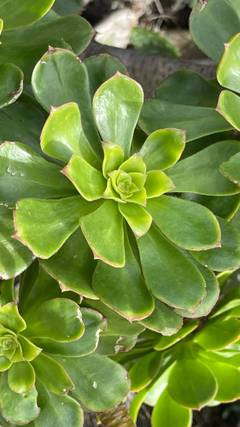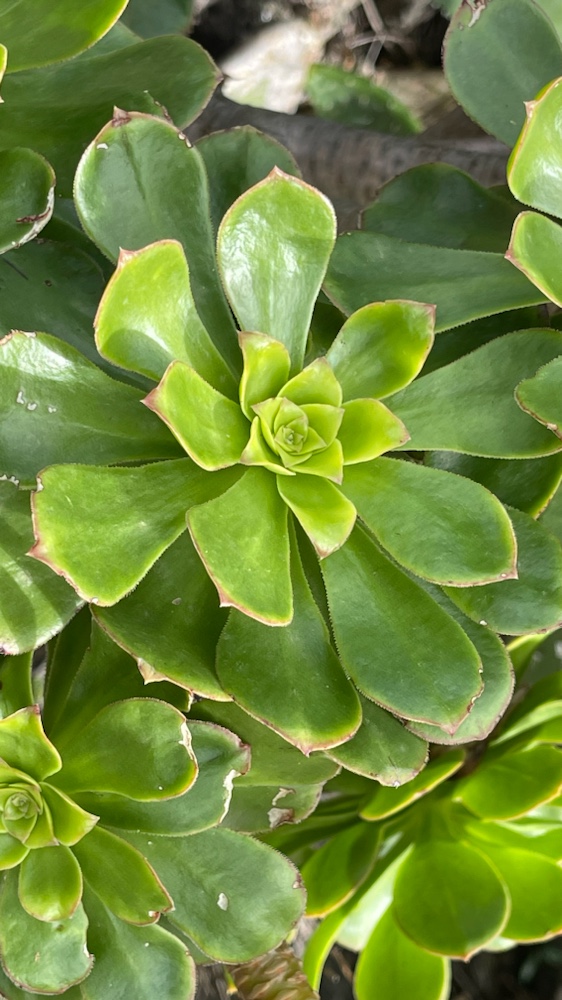
Aeonium, Genus, spp., Multiple species,
- Genus
- Multiple species
tree houseleeks
Canary Islands and other Atlantic islands, Morocco, and East Africa
Overview
Aeonium is a genus of about 35 species of succulent perennials and subshrubs in the stonecrop family (Crassulaceae), native to the Canary Islands and other Atlantic islands, with a few species in Morocco and East Africa. Plants carry flat rosettes of fleshy, spoon-shaped leaves at the tips of bare or branching woody stems, ranging from ground-hugging clusters to shrubby forms 1 to 6 ft (30 to 180 cm) tall; individual rosettes span 2 to 12 in (5 to 30 cm). Leaf color runs from green through chalky blue to deep purple-black and variegated cream, deepening in strong sun. Cone-shaped clusters of small yellow, white, or pink star flowers rise from the center of a mature rosette, after which that rosette dies, since most species are monocarpic and flower only once. Branching species replace the spent rosette with side shoots, while single-stemmed kinds die after blooming. The genus grows on rocky slopes and cliffs in a mild, frost-free Mediterranean-type climate with cool, moist winters and dry summers, so many species grow in winter and rest in the heat. Aeonium is frost-tender and is grown outdoors only in mild regions or as a container plant moved under cover for winter.
Native Range
Aeonium is native mainly to the Canary Islands, with additional species on Madeira and the Cape Verde and Selvagens islands, and a few in Morocco and East Africa. It grows on rocky outcrops, cliffs, and dry slopes in mild, frost-free coastal climates.Suggested Uses
Aeonium is grown in containers, rock gardens, and gravel beds in mild climates, and as a houseplant or patio plant moved indoors for winter elsewhere. The dark-leaved kinds are used for contrast in succulent plantings and mixed pots.How to Identify
Appearance
Size & Dimensions
Height1' - 6'
Width/Spread1' - 3'
Bloom Information
Aeonium blooms in late winter to spring, roughly February to May, when a tall cone of small yellow, white, or pink flowers rises from the rosette center. Each rosette flowers only once and then dies, so bloom marks the end of that rosette. Branching species carry on from side shoots, while single-stemmed species die after flowering.
Detailed Descriptions
Flower Description
yellow, white, or pinkFoliage Description
green, blue-green, purple-black, or cream-variegatedGrowing Conditions
Sun Requirements
Requires 4-10 hours of direct sunlight daily
• Full Sun: 6+ hours of direct sunlight
• Partial Shade: 3-6 hours of direct sunlight
• Full Shade: Less than 3 hours of direct sunlight
Care & Maintenance
Care Guide
Aeonium grows in full sun to part shade on gritty, sharply drained soil, and many species grow through the cool, moist months and rest in summer heat, the reverse of most succulents. It is frost-tender, hardy only in USDA zones 9 to 11, and is grown in containers moved under cover where winters freeze. Water is given as the soil dries during the growing season and held back during summer dormancy, when overwatering rots the roots and stems. Strong light deepens the leaf color, while deep shade makes the rosettes loose and pale. The shallow roots suit wide, shallow pots, and leggy stems are cut and re-rooted to renew old plants.Pruning
Leggy or bare stems are cut back and the cut rosettes re-rooted to keep plants compact. Spent flower cones and the rosettes that bore them are removed once they die. Dead lower leaves are stripped from the stems to limit rot and pests.Container Growing
Suitable for container growing
Minimum container size: 2 gallons