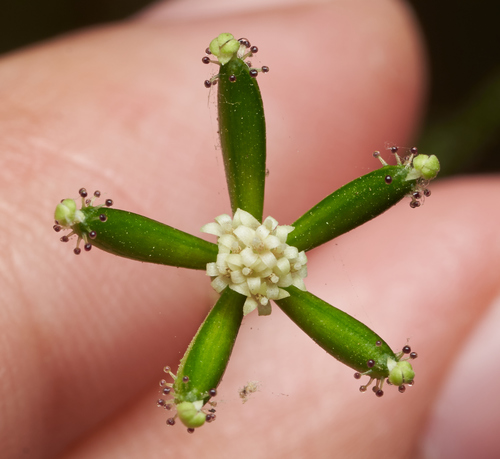
Adenocaulon, Genus, spp., Multiple species,
- Genus
- Multiple species
trail plant
Western North America, eastern Asia, and southern South America
Overview
Adenocaulon is a small genus of herbaceous perennials in the daisy family, with about five species scattered across western North America, eastern Asia, and southern South America. One widespread species, A. bicolor, grows on the floor of moist conifer and mixed woodland. Plants form a low rosette of long-stalked, triangular to heart-shaped leaves 2-6 inches (5-15 cm) wide, green above and densely white-woolly beneath, so a breeze or a footstep that flips them leaves a pale trail through the undergrowth. From the rosette rises a slender, branched, almost leafless stem 1-3 feet (30-90 cm) tall, carrying tiny heads of small whitish flowers that are easy to overlook. The fruits are club-shaped and coated in stalked, sticky glands that cling to fur, feathers, and clothing, carrying the seed away from the parent. The genus needs cool, shaded, humus-rich and steadily moist soil and fades in dry, sunny, or compacted ground. Top growth dies back in winter and returns from the rootstock in spring.
Native Range
Adenocaulon is spread across cool temperate regions in a broken pattern: A. bicolor in western North America from British Columbia to California, other species in eastern Asia, and one in the southern Andes of Chile and Argentina. All grow in shaded, moist forest understorey on rich, leafy soils.Suggested Uses
Grown mainly in woodland and native-plant gardens as a shade-tolerant ground layer under trees and shrubs. It suits naturalistic and restoration plantings on moist forest soils rather than formal borders. The white-backed leaves give a low textural carpet in dappled shade.How to Identify
Appearance
Size & Dimensions
Height1' - 3'
Width/Spread1' - 2'
Bloom Information
Flowering comes in summer, roughly June to August, on tall branched stems above the leaves. The flower heads are small, few-flowered, and whitish, without showy ray petals. They are followed by the sticky, clinging fruits that give the trail plants their name.
Detailed Descriptions
Foliage Description
green above, white beneathGrowing Conditions
Sun Requirements
Tolerates up to 4 hours of direct sunlight daily
• Full Sun: 6+ hours of direct sunlight
• Partial Shade: 3-6 hours of direct sunlight
• Full Shade: Less than 3 hours of direct sunlight
Care & Maintenance
Care Guide
Grow in full to part shade in cool, humus-rich soil kept evenly moist, mimicking a woodland floor. Water through dry spells, as the shallow roots suffer in drought and the leaves wilt quickly in sun. No feeding is needed beyond an annual mulch of leaf litter, which maintains the moist, fertile rooting layer it favours. Plants are hardy in roughly USDA zones 6 to 9 and need no winter protection within that range. They self-sow where conditions stay damp and shaded, and seedlings can be moved while small.Pruning
Little pruning is needed. Spent flower stems can be cut back after the fruits ripen to limit self-seeding where the plant spreads too freely. Dead foliage is cleared in late autumn as the rosette dies down.Pruning Schedule
fall
