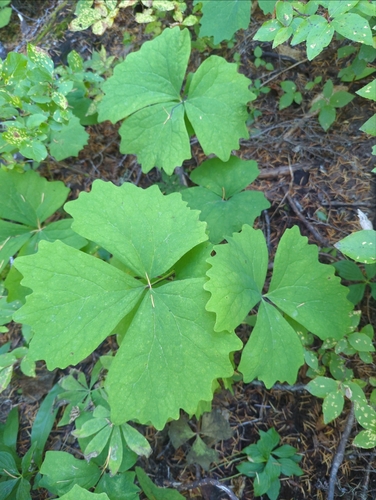
Achlys, Genus, triphylla, Species,
- Genus & species
Vanilla leaf
Pacific Northwest — British Columbia south to northern California, east to Idaho and Montana; moist conifer forest understory beneath Douglas-fir, western hemlock, and western red cedar
Overview
Achlys triphylla is a low spreading deciduous perennial ground cover reaching 6-16 inches (15-40 cm) tall and 12-24 inches (30-60 cm) wide. Spreads slowly but indefinitely by underground rhizome to form an even low cover under conifers. Each leaf bears three fan-shaped to broadly wedge-shaped deeply scalloped leaflets on a long slender petiole, with each leaflet 2-4 inches (5-10 cm) across (triphylla = three-leaved). White petalless flowers consisting only of exposed stamens are densely packed in cylindrical spikes 1-3 inches (2.5-7.5 cm) long, held above the foliage on slender naked stems from April through June over 6 weeks. Dried foliage emits a strong vanilla scent from coumarin compounds — the source of both the common name vanilla-leaf and the alternative name sweet after death. Indigenous peoples of the Pacific Northwest traditionally hung dried bunches in homes as a natural air freshener and insect repellent, a practice that continues today. Native to the Pacific Northwest from British Columbia south to northern California, east to Idaho and Montana. Found in moist conifer forest understory beneath Douglas-fir, western hemlock, and western red cedar. Fails in hot dry sites; cool moist shaded conditions are required for establishment. Foliage turns yellow in fall. Non-toxic. Hardy in USDA zones 5-9.
Native Range
Native to the Pacific Northwest — British Columbia south to northern California, east to Idaho and Montana. Found in moist conifer forest understory beneath Douglas-fir, western hemlock, and western red cedar at low to mid elevations.Suggested Uses
Used as a native ground cover in shaded woodland gardens, native plant gardens, and beneath conifers, spaced 12-24 inches (30-60 cm). The dried foliage retains its vanilla scent for months and is gathered for sachets and indoor arrangements. Cool moist shade is required.How to Identify
Appearance
Size & Dimensions
Height6" - 1'4"
Width/Spread1' - 2'
Bloom Information
White petalless flowers consisting only of exposed stamens appear in dense cylindrical spikes 1-3 inches (2.5-7.5 cm) on slender naked stems above the foliage from April through June over 6 weeks. Bee-pollinated. Plants in deeper shade may not flower in any given year; reliable bloom requires at least 2-3 hours of dappled light.
Detailed Descriptions
Flower Description
White, tiny petalless flowers consisting only of exposed stamens; densely packed in a cylindrical spike 1-3 inches (2.5-7.5 cm) on a slender naked stem held above the foliage; April-JuneFoliage Description
Dark green above, paler beneath; three fan-shaped to broadly wedge-shaped deeply scalloped leaflets per leaf, each 2-4 inches (5-10 cm) across, on long slender petioles; the dried foliage emits a strong vanilla scent from coumarin compounds — the source of the common names; turns yellow in fallGrowing Conditions
Sun Requirements
Tolerates up to 3 hours of direct sunlight daily
• Full Sun: 6+ hours of direct sunlight
• Partial Shade: 3-6 hours of direct sunlight
• Full Shade: Less than 3 hours of direct sunlight
Care & Maintenance
Care Guide
Grows in full shade to partial shade with 0-3 hours direct light. Requires moist humus-rich soil — loam, peat, or clay — at pH 5.0-7.0. Hardy in USDA zones 5-9. Cool moist conifer forest understory conditions are essential; declines rapidly in hot dry sites or where summer irrigation is insufficient. Deer-resistant. Non-toxic.Pruning
No regular pruning required. Remove any winter-damaged foliage in February or early March before new growth emerges. The species spreads slowly by rhizome and rarely needs containment.Pruning Schedule
Prune: February–March
early spring