Turf Care

Cool-Season vs Warm-Season Grass: Which Type Is Right for Your Lawn?
Last updated: October 30, 2025
Cool-season and warm-season grasses peak at opposite temperatures and require completely different care calendars. Here's how to tell them apart, when each type thrives, and which to choose for your lawn.
JJames Martinez
October 30, 2025
Share:
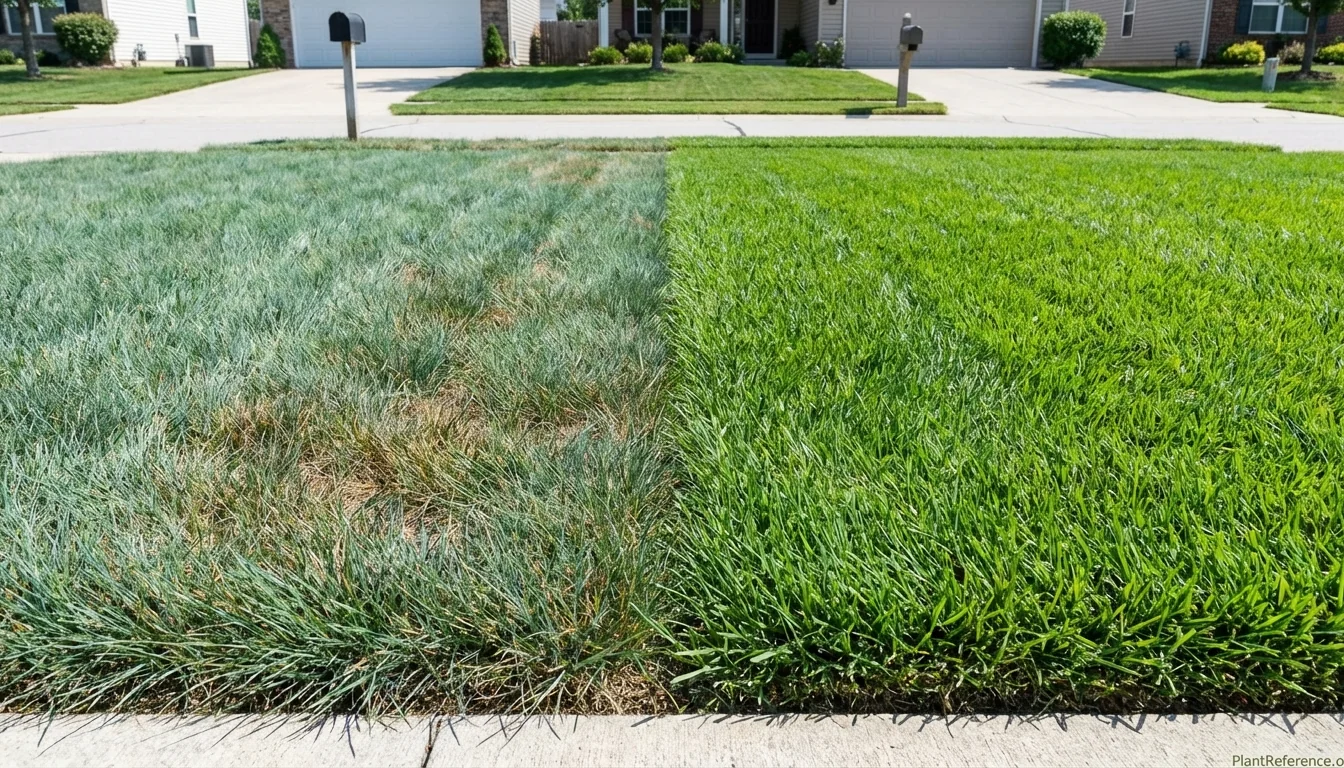
Split lawn view showing actively growing cool-season grass in spring green alongside dormant brown warm-season grass

Image © PlantReference.org 2026
Quick Answer
Cool-season grasses peak in spring and fall at 60–75°F; they suit the northern U.S. Warm-season grasses peak in summer at 80–95°F; they suit the South. Each type goes dormant at the other's peak temperature.
TL;DR
Cool-season grasses — including Poa pratensis (Kentucky bluegrass) and Festuca arundinacea (tall fescue) — peak at 60–75°F (16–24°C), thrive in the northern U.S., and go dormant in summer heat. Warm-season grasses — including Cynodon dactylon (bermudagrass) and Zoysia japonica (zoysiagrass) — peak at 80–95°F (27–35°C), dominate the South, and go brown when soil temperatures drop below 55°F (13°C). The wrong choice for your climate costs money, water, and labor every single season.
Frequently Asked Questions

How do I know if my lawn is cool-season or warm-season grass?

The most reliable test is observation over time: if your lawn is actively green in October and November and struggles in July, it's cool-season. If it goes brown in November–December and greens up in late April or May, it's warm-season.

Can I overseed warm-season grass with cool-season grass for year-round green?

Yes — overseeding dormant warm-season lawns with Lolium perenne (perennial ryegrass) in October–November is standard practice across the South and Transition Zone for year-round color. The ryegrass establishes through fall and winter while the primary warm-season grass is dormant.

Why does my cool-season lawn look bad in summer?

Heat stress. Cool-season grasses slow dramatically above 85°F (29°C) and may go dormant — turning brown — during hot, dry summer periods. This is the normal, healthy survival response of a C3 grass to temperatures outside its optimal range. It is not a disease or deficiency problem.

What is the difference between dormancy and a dead lawn?

Dormant grass looks brown but has living crowns and roots. Dead grass has no living tissue. The tug test: grab a handful of dormant-looking grass and pull firmly. Dormant grass resists pulling with its intact root system; dead grass pulls out easily with no resistance and the roots look dark, wet, and decomposed.
NEW PLANT DAILY

Think you know your plants?

Test your botanical knowledge with a new plant identification challenge every day. Build your streak, learn fascinating plant facts, and become a plant identification expert!

Build your streak
One chance per day
Learn as you play

Free account required • Takes less than 30 seconds

Written By
J

James Martinez

James is a lawn care professional in Dallas who runs a small residential maintenance company. He started mowing lawns as a teenager and worked his way up to running crews for a large landscaping firm before going out on his own. James specializes in warm-season turf grasses—Bermuda, St. Augustine, and Zoysia—and knows how to keep a lawn alive through Texas summers without wasting water. He's also experienced with the transition zone challenges that Dallas faces, where warm-season and cool-season grasses overlap. James takes a practical, science-informed approach to lawn care and pushes back on the idea that a good lawn requires heavy chemical inputs.

Related Plants

Other Articles You May Enjoy