1 / 3
Broadleaf Evergreen Shrubs
Lonicera ligustrina var. yunnanensis 'Baggesen's Gold'
Golden box honeysuckle
Caprifoliaceae
Species native to southwestern China (Yunnan, Sichuan); cultivar selected in Kent, England
At a Glance
TypeShrub
HabitMounding
FoliageEvergreen
Height4-6 feet (1.2-1.8 m)
Width4-6 feet (1.2-1.8 m)
Maturity5 years
Growing Zones
USDA Hardiness Zones
6 - 9Zone 6
Zone 7
Zone 8
Zone 9
These zones indicate the coldest temperatures this plant can typically survive.
Frost Tolerancehardy
Key Features
Attracts Pollinators
Drought Tolerant
Fragrant (light)
Container Friendly
Maintenancemoderate
Overview
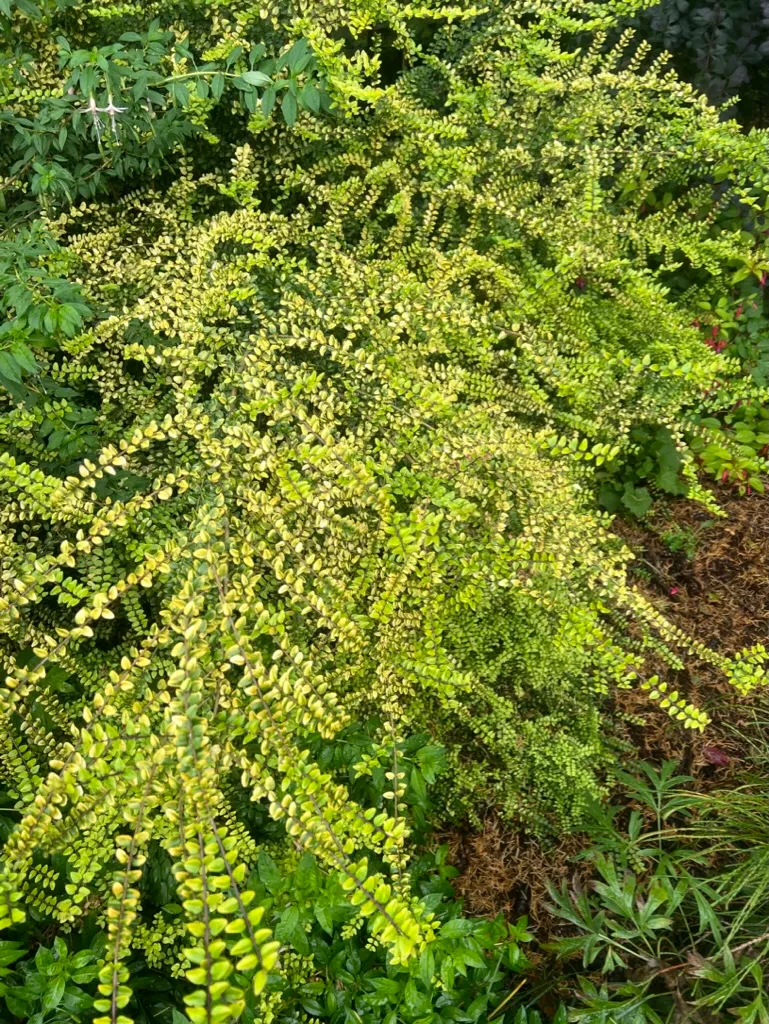
A cultivar of Lonicera ligustrina var. yunnanensis forming a dense, rounded to arching evergreen shrub reaching 4-6 feet (1.2-1.8 m) tall and 4-6 feet (1.2-1.8 m) wide at maturity. Growth rate is moderate, adding 6-10 inches (15-25 cm) per year. This cultivar is distinguished from the species type by its golden-yellow to chartreuse foliage. Leaves are opposite, small, ovate, 0.5-1 inch (1.3-2.5 cm) long, emerging bright golden-yellow in spring and summer in full sun, becoming more chartreuse-green in partial shade. In winter, foliage often develops yellow-green to olive tones, less vivid than the summer coloring. Stems are thin and wiry with a slightly arching habit, giving the plant a softer silhouette than the more rigid species type. Small, tubular, creamy-white flowers approximately 0.3 inches (8 mm) long appear in pairs at leaf axils in May to June, with a light, sweet fragrance. Fruit is a small, translucent purple-black berry approximately 0.2 inches (5 mm) in diameter, produced sparsely. Semi-evergreen to evergreen depending on winter severity; fully evergreen in zones 8-9, may lose partial foliage in zones 6-7 during severe cold. Hardy to approximately 0°F (-18°C). Foliage color intensity varies with light exposure: full sun produces the brightest golden tones, while heavy shade results in lime-green to chartreuse foliage with less yellow saturation. Branches that revert to green foliage should be removed.
Native Range
The species Lonicera ligustrina var. yunnanensis is native to southwestern China, primarily Yunnan and Sichuan provinces, found on mountain slopes and in scrubland at 3,000-10,000 feet (900-3,000 m) elevation. The cultivar 'Baggesen's Gold' was selected by the Baggesen Nursery in Pembury, Kent, England.Suggested Uses
Commonly used as a golden-foliage accent in mixed borders, as formal or informal hedging at 2-3 foot (60-90 cm) spacing, and for topiary. Provides foliage color contrast when planted adjacent to dark green or purple-leaved shrubs. Suitable for containers of at least 5 gallons (19 L). Tolerates urban pollution and coastal exposure.How to Identify
Appearance
Size & Dimensions
Height4' - 6'
Width/Spread4' - 6'
Reaches mature size in approximately 5 years
Colors
Flower Colors
cream
white
Foliage Colors
golden yellow
chartreuse
lime green
Bloom Information
Bloom Period
~3 weeksJ
F
M
A
M
J
J
A
S
O
N
D
SpringSummer
Detailed Descriptions
Flower Description
Creamy-whiteFoliage Description
Golden-yellow to chartreuse in sun; lime-green in shade; yellow-green to olive in winterGrowing Conditions
Sun Requirements
Full Sun
Partial Shade
Requires 4-8 hours of direct sunlight daily
• Full Sun: 6+ hours of direct sunlight
• Partial Shade: 3-6 hours of direct sunlight
• Full Shade: Less than 3 hours of direct sunlight
Soil Requirements
pH Range5.5 - 7.5(Neutral)
357912
Soil Types
loamclaysand
Drainage
well drained
Water & Climate
Water Needs
Medium
Frost Tolerance
hardy
Time to Maturity
3-5 years
Drought Tolerance
Drought tolerant when established
Care & Maintenance
Care Guide
Plant in full sun for the brightest golden foliage color; in partial shade, foliage develops chartreuse to lime-green tones with less yellow saturation. Tolerates a wide range of soil types and pH from 5.5 to 7.5. Water regularly during the first growing season; established plants tolerate moderate dry periods of 2-3 weeks. Mulch with 2 inches (5 cm) of organic material. Remove any branches that revert to all-green foliage at their point of origin, as reverted shoots are more vigorous. Powdery mildew may develop in humid, poorly ventilated locations; improve air circulation through selective thinning. Aphids may colonize new growth in spring. In zones 6-7, site in a sheltered position to reduce winter foliage loss.Pruning
Responds well to shearing and is commonly maintained as formal hedging or topiary. Prune or shear 2-3 times during the growing season from late spring through mid-summer to maintain dense shape and encourage the production of colorful new growth. Hard rejuvenation pruning to 6-12 inches (15-30 cm) in late winter is tolerated; regrowth fills in within 1-2 growing seasons. Remove any all-green reverted branches at their point of origin at any time of year. Avoid late fall pruning.Pruning Schedule
J
F
M
A
M
J
J
A
S
O
N
D
late springsummer
Maintenance Level
moderateContainer Growing
✓ Suitable for container growing
Minimum container size: 5 gallons