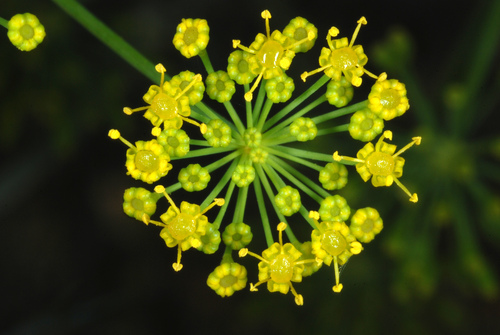
Anethum, Genus, graveolens, Species,
- Genus & species
dill
Native to the Mediterranean and southwestern Asia, where the species has been cultivated for at least 5,000 years across the historical record; widely naturalized along roadsides and waste ground in temperate regions following European colonial-era introduction; the cool spring and early summer of the Pacific Northwest extends the leafy foliage stage before bolting and gives a longer dill weed harvest window than hot continental climates allow before plants set seed
Overview
Anethum graveolens is an erect annual herb in the carrot family (Apiaceae) reaching 24-48 inches (60-120 cm) tall with a 12-18 inch (30-45 cm) spread. Stems are erect, smooth, hollow, blue-green, with narrow longitudinal ridges. Leaves are alternate, narrowly dissected into thread-like (filiform) segments, feathery, blue-green, strongly aromatic with an anise-like scent the species is known for. Flowers are tiny, yellow, carried in compound umbels 4-8 inches (10-20 cm) across. Fruit (seed) is flattened, oval, 0.1-0.2 inch (3-5 mm) long, ribbed, strongly aromatic. Both the foliage (dill weed) and the seeds (dill seed) are used in cooking, with the foliage carrying a lighter grassier flavor while the seeds are more pungent and warming. The taproot is slender and does not tolerate transplanting well, so direct sowing is the standard method. Plants bolt rapidly in heat above 75°F (24°C). In the Pacific Northwest, successive sowings every 2-3 weeks extend the harvest of fresh foliage. The species is a host plant for swallowtail butterfly larvae (Papilio species), which is a secondary garden value beyond the culinary use.
Native Range
Anethum graveolens is native to the Mediterranean and southwestern Asia. The species has been cultivated for at least 5,000 years and is widely naturalized along roadsides and waste ground in temperate regions.Suggested Uses
Used in herb gardens, kitchen gardens, and container plantings of 3 gallons or more. Foliage (dill weed) is used fresh in fish dishes, salads, dips, and sauces. Seeds (dill seed) are used in pickling, bread, and spice blends. Planted as a beneficial insect attractant in vegetable gardens since the umbels host parasitic wasps and other biological control agents. Host plant for swallowtail butterfly larvae. Used in windowsill and balcony herb gardens in containers of 3+ gallons.How to Identify
Appearance
Size & Dimensions
Height2' - 4'
Width/Spread1' - 1'6"
Bloom Information
Flowers from June through August across a 3-week bloom window per umbel. Compound umbels open progressively from the central terminal head outward to lateral branches. Pollinated by bees and beneficial insects (predatory wasps, hoverflies, lacewings) attracted to the open landing-pad umbel form. Seeds mature 2-3 weeks after flowering. Once the flower stalk elongates (bolting), the foliage flavor diminishes. Seed harvest occurs when the seeds turn brown and the umbel begins to dry.
Detailed Descriptions
Flower Description
Yellow tiny flowers carried in compound umbels 4-8 inches (10-20 cm) across; the umbel structure is shared across the carrot family (Apiaceae) and attracts beneficial insects through the open landing-pad formFoliage Description
Blue-green narrowly dissected into thread-like (filiform) segments; feathery; aromatic with an anise-like scent when leaves are crushed or brushed againstGrowing Conditions
Sun Requirements
Requires 6-12 hours of direct sunlight daily
• Full Sun: 6+ hours of direct sunlight
• Partial Shade: 3-6 hours of direct sunlight
• Full Shade: Less than 3 hours of direct sunlight
Care & Maintenance
Care Guide
Direct sow seeds 0.25 inch (6 mm) deep after the last frost date, spacing 12 inches (30 cm) apart. Successive sowings every 2-3 weeks extend the fresh foliage harvest through summer. In the Pacific Northwest, sow from April through July. Consistent moisture supports leafy growth — drought stress triggers premature bolting that ends the foliage harvest. The slender taproot does not transplant well, so direct sowing is the standard practice. Tall cultivars are staked or planted in a sheltered location to prevent wind lodging. Harvest foliage (dill weed) before flowering for the strongest flavor. Some plants are allowed to flower and set seed for dill seed harvest and to attract beneficial insects to the surrounding garden.Pruning
Pinch growing tips to delay bolting and extend the foliage harvest. Cut foliage stems as needed, leaving at least one-third of the plant intact. Cut entire seed heads when seeds are brown and dry, then place the heads upside down in a paper bag to catch falling seeds.Container Growing
Suitable for container growing
Minimum container size: 3 gallons